
High-frequency trading involves infrastructure and strategies designed around very short time horizons. Most retail traders do not operate in that environment and do not need to compete on the same terms. What matters to them is how market structure affects the prices, liquidity, and fills they receive. Faster software alone does not create the advantages of a specialized trading firm.
What High-Frequency Trading Is
If you strip away the Hollywood mystique, HFT is a pretty basic concept taken to an absurd extreme. It relies on automated systems to place, adjust, and cancel thousands of trades faster than a human could ever process. No hesitation, no second-guessing, and definitely no revenge-trading after a loss. Just pure logic, probability, and relentless execution. HFT is more of a business model than a trading strategy. It’s a cocktail of low-latency tech, instant market data, strict risk controls, and a flood of short-lived orders. Yes, speed is the main character, but queue position, trading fees, and solid connections to different venues matter just as much. Setting up a fast gaming rig at home doesn’t make you an HFT trader; these firms operate in a completely different universe.
And not all HFT strategies do the same thing. Some algorithms act as market makers, constantly offering buy and sell prices to collect the spread. Others hunt for fleeting price gaps between different liquidity providers. Some react exclusively to breaking news, while others just monitor order flow to manage risk before their competitors do. The one thing they all share isn’t the strategy itself—it’s the ticking clock. HFT firms couldn't care less where EUR/USD will be next month. They only care about the next few seconds, milliseconds, or even the next micro-burst of buying and selling.
Think of it this way: if traditional investing is a long cross-country road trip, and day trading is navigating rush-hour city traffic, HFT is a Formula 1 race where the finish line shifts every millisecond and the prize money for each lap is just pennies. They aren't swinging for home runs. The goal is to squeeze out a tiny edge, over and over, until those pennies turn into millions.
Because of this, real HFT looks nothing like the movies. There’s no guy in suspenders screaming into a phone. It’s just quiet server rooms, millions of lines of code, and teams of engineers and math nerds obsessing over how to shave a microsecond off their connection speed so they don't get caught holding the bag.
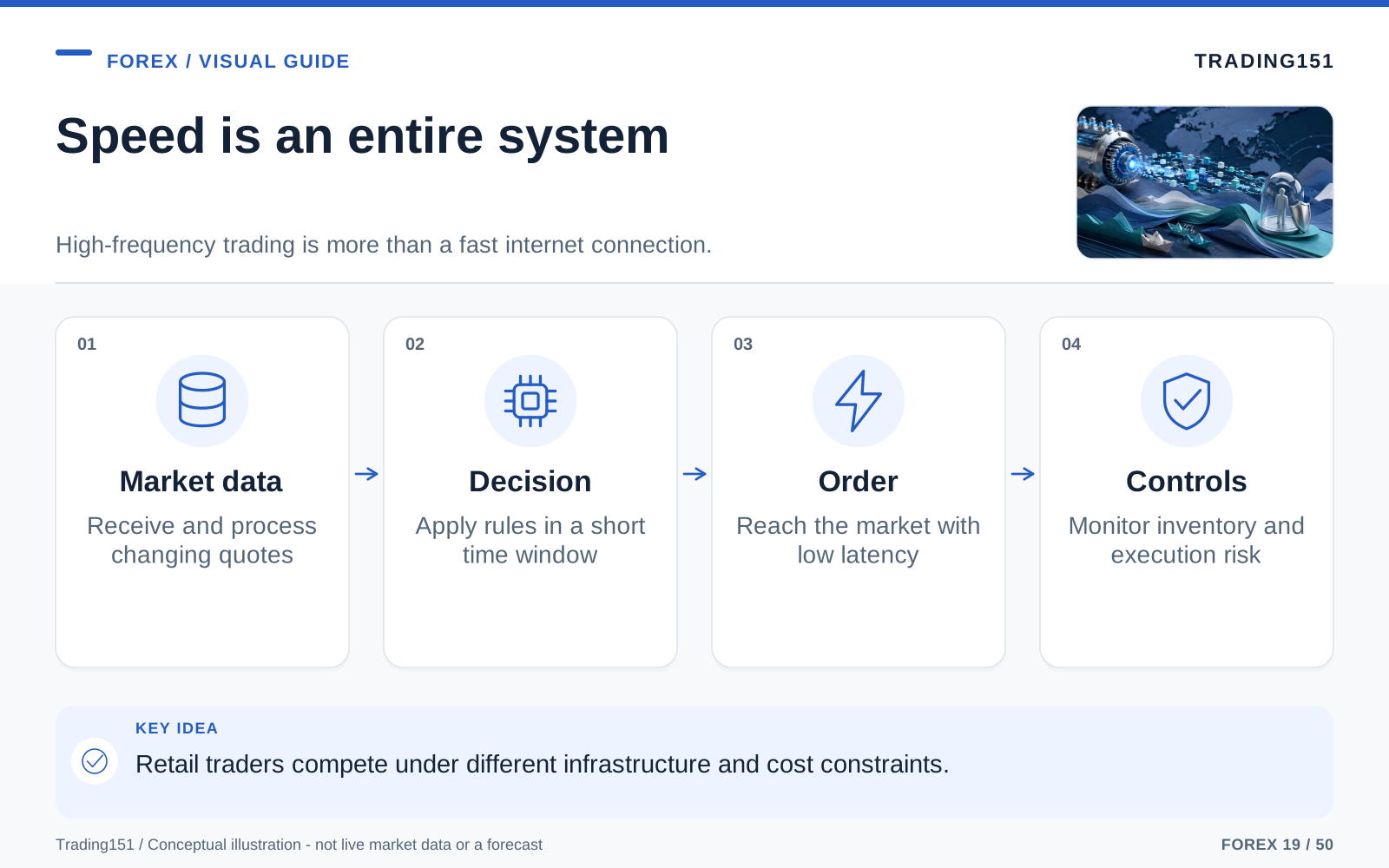
Read this diagram as text
- Market data
- Receive and process changing quotes
- Decision
- Apply rules in a short time window
- Order
- Reach the market with low latency
- Controls
- Monitor inventory and execution risk
Why Forex Became a Natural Home for HFT
If you set out to design the perfect playground for speed-obsessed trading bots, you’d probably invent Forex. It has a few unique quirks that make it completely irresistible to these firms.
For starters, it’s unusually liquid. Major currency pairs move large amounts of money. This is vital because HFT strategies rely on slipping in and out of the market without causing a splash. In a low-volume market, a quick burst of orders will drastically move the price, ruining the trade. But in the deep oceans of Forex, fast firms have enough room to operate completely unnoticed.
Then there's the decentralized nature of the market. Unlike stocks, which generally trade on a main exchange, Forex is scattered across a messy global web of banks, brokers, and electronic networks. Because the market is so fragmented, slight pricing inconsistencies pop up constantly. If your computers are fast enough, those tiny errors are basically free money.
Forex also never really sleeps. The action just hands off from one financial hub to the next—London, New York, Tokyo, Sydney. Spreads widen and tighten, and volatility ebbs and flows around the clock. For an algorithm, this means the buffet is open almost all week.
Finally, the game is won in the smallest possible increments. Currency trading is a game of fractions of a pip. That might sound like a rounding error to you and me, but when you scale those tiny advantages across large daily volumes, the profits are staggering. A setup that looks entirely pointless to a human trader can be a goldmine for an industrial-scale algorithm.
Add it all up, and Forex is basically utopia for machines. The data never stops flowing, the inefficiencies are always there, and the volume is high enough to support a business built on endless repetition rather than big, bold predictions.
Why Speed Matters So Much
A lot of folks assume HFT firms make their money by just being smarter than everyone else. Brainpower helps, sure, but in this corner of the financial world, speed isn’t just an advantage—it is the entire business.
Imagine two hedge funds running the same strategy. Both spot the same pricing error. Both know exactly what to do. If one hits the market even a millisecond earlier, they get the fill. The slower firm might be 100% right about the market, but their order arrives to an empty room. In the ultra-fast lanes of Forex, being right but late is exactly the same as being wrong.
This is why HFT firms drop dizzying amounts of money on their tech setup. They physically park their servers as close to the exchange's matching engines as legally allowed. They tweak their code not to be smarter, but to execute faster. They lose sleep over network cables, hardware latency, and transmission paths. To an outsider, it looks insane—entire engineering teams dedicated to saving a thousandth of a second. But when your entire profit model relies on getting to a price discrepancy before the next guy, those tiny fractions of a second are the only thing keeping the lights on.
In a way, HFT has turned trading into a bizarre technological arms race. Back in the day, a trader’s edge was better research, insider connections, or a great gut feeling about macroeconomics. Those things still matter for normal investors, but for HFT? The edge usually boils down to something painfully simple: who crossed the finish line first.
How HFT Firms Make Money in Forex
It’s easy to talk about HFT like it’s one giant, shadowy monolith. It’s not. Different firms have different playbooks, and many mix and match their approaches. Still, almost everything they do falls into a few distinct buckets. Keep in mind, their profit margins per trade are razor-thin. Whether they are capturing the spread or exploiting a quick arbitrage gap, the money comes from doing it flawlessly millions of times, not from guessing what the Euro will do next Thursday.
1. Market Making
One of the most common ways HFT firms operate is by acting as market makers. They constantly offer a price to buy and a slightly higher price to sell. That gap is the spread, and if they do it enough times, pocketing that spread becomes a large income stream.
It sounds like an easy, mechanical way to print money, but it’s risky. A market maker can get absolutely crushed if the market suddenly tanks. If a major news headline drops and prices spike, a quote that looked safe a millisecond ago suddenly becomes a large liability. That’s why speed is crucial. These bots are constantly adjusting their quotes, managing their risk, and pulling their money off the table the second things look sketchy.
For retail traders, this presents a weird paradox: the same algorithms that feel like predatory robots are the reason we get those tight spreads on major currency pairs. When they are in the market, trading is cheaper for all of us. When they vanish, the market gets choppy and expensive.
2. Arbitrage
Arbitrage is the purest example of what computers do best. If the same currency is priced slightly differently on two different exchanges, an algorithm can buy the cheap one and sell the expensive one before the gap closes.
In Forex, this usually looks like triangular arbitrage. The system scans the exchange rates of three different currency pairs, looking for a fleeting moment where the math breaks. The discrepancy is usually microscopic and might only exist for a blink of an eye. You and I would never see it. But to a bot built specifically to look for it, it’s a flashing neon sign.
These glitches don't last. The moment the HFT firm exploits the gap, the act of trading it forces the prices back into alignment. This is why HFT can make markets more efficient. The machines get rich off the errors, but by doing so, they immediately fix them.
3. Latency Arbitrage
This is where things get a bit spicy. Latency arbitrage isn't about finding a real economic mismatch; it’s about having a faster connection than the next guy. If one exchange updates its price, but another exchange is lagging by a fraction of a second, a fast firm will snipe the outdated quote before the slower exchange can catch up.
Proponents will tell you this is just the reality of a free, competitive market. Critics will tell you it’s basically a speed tax—a way to squeeze money out of slower traders just because you can afford better fiber-optic cables. Whatever your take, it perfectly highlights how the plumbing of modern markets has become a trading strategy all on its own.
4. News-Driven Trading
Big data drops—like inflation reports, jobs data, or surprise rate hikes—can send currencies into a tailspin. HFT firms design software that can read these data releases instantly and start trading on them before a human could even finish reading the headline.
Think about your own process: you see the news, take a breath, think about what it means, and then click buy or sell. An HFT bot completely bypasses the thinking phase. It compares the actual number to the expected number, calculates the historical market reaction, and starts firing off orders.
If you've ever wondered why the market violently spikes the literal millisecond a news report drops, this is why. By the time your finger clicks the mouse, the smart money has already made their move and exited the trade.
What HFT Changed for the Rest of the Market
It’s tempting to treat HFT as the bad guy. It’s an easy narrative to sell: ultra-rich firms using supercomputers to steal pennies from the little guy. And sometimes, it really is unfair. But the reality is a lot more nuanced.
On the bright side, HFT gives us better prices. The fierce competition among algorithms has dramatically lowered the spreads on major currency pairs. For everyday traders, that’s a big deal. Tighter spreads mean less friction, which means you start losing less money just to enter a trade.
It also makes it easier to get your orders filled. We’ve all gotten used to clicking a button and instantly being in a trade at a stable price. HFT is a big reason why that works. Under normal conditions, there’s almost always a bot on the other side of your screen willing to take your trade.
And it cleans up market errors. Because algorithms are constantly hunting for pricing mistakes, obvious errors get ironed out immediately. It keeps the market relatively sane and consistent.
But that convenience comes with a pretty dark trade-off.
The liquidity is an illusion when things get scary. HFT firms are happy to provide liquidity when the waters are calm. But the second volatility spikes—like during a major geopolitical event—they pull their orders and head for the hills. The liquidity you thought was there suddenly evaporates into thin air.
Speed can trigger absolute chaos. Algorithms don't feel fear, but their programming can mimic a stampede. If a bunch of different bots are reading the same bearish signal, they will all start aggressively selling at the same millisecond. Orders get yanked, selling snowballs, and what should have been a normal dip turns into a freefall. Once the bots start feeding off each other, the market can severely overreact.
It creates a large gap between the pros and the joes. A guy in his bedroom with a laptop, a WiFi connection, and TradingView isn't playing the same sport as an institution with a dedicated server room plugged directly into the exchange. That doesn't mean retail traders are doomed; it just means you can't play their game and expect to win.
The Darker Side: Flash Crashes, Spoofing, and Fragility
When you connect a bunch of hyper-fast systems together, minor hiccups can snowball into large disasters. Finance is no exception. Automated systems can accidentally trigger large sell-offs if liquidity dries up or if they all interpret the same data incorrectly. Then there’s spoofing—the shady practice of placing fake orders just to trick other traders before canceling them. While spoofing is illegal, standard order cancellation is just how electronic trading works. Telling the difference comes down to intent, so retail traders shouldn't just assume every disappearing order book is a large conspiracy.
But the real boogeyman of the HFT world is the flash crash. These are those concerning, inexplicable market plunges that seem to happen for absolutely no reason. They’re scary not just because they drop so fast, but because they expose a hard truth: the market is only stable when the algorithms think it’s safe. Once that illusion breaks, the bots can make things a thousand times worse by either joining the panic or just unplugging entirely.
Then you have order book manipulation. Basically, this is when a firm places large buy or sell orders that they have zero intention of executing. They do it to create a mirage of heavy demand, tricking other algorithms into reacting, and then they profit off the resulting price move. Not every HFT firm plays dirty, but the speed of these systems definitely opens the door for abuse.
Finally, there’s the silent issue: structural fragility. The Forex market might look deep and healthy on your charts, but underneath, it’s fragile. We rely heavily on a tangled web of algorithms, dark pools, and routing software. When something glitches—a bad piece of code, a misread news headline, or a sudden lack of buyers—the fallout is severe.
This is why watchdogs and regulators are constantly scratching their heads. At what point does an ultra-fast market stop being competitive and start becoming a hazard? How much speed do we really need before the system just breaks?
Is Forex Rigged for Normal Traders?
Let's get straight to the question everyone is really asking.
Here’s the blunt truth: if you are trying to scalp tiny, one-minute chart movements, you are willingly walking into a slaughterhouse. If your strategy relies on out-reacting sudden bursts of momentum or winning a speed race against multi-million-dollar supercomputers, you are playing the exact game they want you to play. And you will lose.
But does that mean Forex is totally rigged against you? Not exactly. It just means the playing field isn't flat. There are VIP sections to this market. The big boys have structural advantages and backdoor access that you and I will never get from a standard retail brokerage account.
However, this is where a lot of retail traders completely lose the plot. They realize they can't beat the machines at speed, so they assume the whole market is a scam and they can't win at all. Those are two very different things.
Where Human Traders Still Have an Edge
The retail edge was never going to be about speed. Humans are unexpectedly slow compared to machines. But we excel in areas that computers struggle with—areas that require nuance, patience, and big-picture thinking. Your advantage isn't a faster internet connection; it's the freedom to step back, ignore the intraday noise, and only take trades when the broader context makes sense. By stepping out of the microsecond trenches, you stop competing with the bots entirely.
Time horizon matters. If you’re trading based on macroeconomic trends over days or weeks, HFT noise is completely irrelevant to you. A shift in global interest rates, a changing political landscape, or long-term inflation data doesn't stop mattering just because an algorithm bought and sold EUR/USD ten thousand times before lunch.
Context matters. Machines are fantastic at following strict rules and processing clean data. They completely short-circuit when the narrative is messy, contradictory, or relies on human emotion. Our judgment isn't perfect, but a human trader can read between the lines of a central bank speech in a way an algorithm simply can't.
Patience matters. Most retail traders bleed their accounts dry because they feel the need to always be doing something. HFT firms have to trade constantly to survive; they live in the chaotic churn of the order book. You don’t. The best thing a human trader can do is just sit on their hands and wait for a fat pitch.
The smartest way to deal with HFT isn’t to complain about it on forums, and it definitely isn't trying to day-trade like a bot. It’s about adaptation. Figure out where the machines live, understand how they distort the 1-minute chart, and then simply refuse to fight them on their own turf.
Speed is only one part of execution quality
Suppose a retail trader reduces the time between a signal and an order by a few milliseconds. That improvement may matter little if the strategy holds positions for days, uses a delayed signal, or pays a spread larger than the expected advantage. The value of speed depends on the strategy's horizon and the source of its expected return.
Examine the whole execution chain: the data feed, signal calculation, connection, broker, liquidity source, and confirmation. A platform showing a quick response is not necessarily delivering the best executable price. Rejected orders, price improvements, adverse slippage, and the treatment of fast markets also belong in the review.
Retail traders usually have more practical control over when and how they trade than over their place in a speed competition. They can avoid sizing a position around an unrealistic fill assumption, check conditions around announcements, and keep enough records to question unusual execution. A slower strategy still needs an edge, but it may not require infrastructure built for a different business.
Be wary of services selling an institutional-sounding latency advantage without explaining the actual contract or venue. A backtest assuming access to prices that were never available to the account is not evidence of a tradable opportunity. The relevant benchmark is achievable execution under your terms, not the speed of a demonstration on someone else's screen.
Speed is not the only execution cost
A faster connection may reduce one source of delay while leaving spreads, queue position, market impact, and adverse price movement unchanged. For a retail trader, the relevant improvement is the result after all costs, not the smallest latency number in an advertisement. Measure the workflow you actually use. Hardware spending is difficult to justify when the strategy's main weakness lies in its rules rather than its execution speed. 1, 2
The Real Meaning of HFT in Forex
High-frequency trading isn’t some sci-fi concept hovering on the fringes of finance. It is the plumbing of the modern Forex market. It dictates the spreads, provides the liquidity, and creates those weird, jerky price movements you see on short timeframes. It’s made trading cheaper in some ways, infinitely more ruthless in others, and highly dependent on tech.
People love to either villainize HFT or worship the tech behind it. Both reactions kind of miss the mark.
HFT isn’t a magical market-fixing tool, nor is it a giant conspiracy meant to steal your money. It’s just capitalism doing its thing. If you create an environment where speed prints money, someone is going to spend billions to be the fastest. If there are tiny, fragmented price errors across different global exchanges, someone is going to build a robot to collect them. It was inevitable.
What you need to understand is the environment it creates. It creates a market where the smallest timeframes belong exclusively to the robots. It creates a space where liquidity is a guarantee—right up until the exact moment you need it. And it proves that technology isn't just a tool used to trade; technology is the trade.
But don't forget: the actual tectonic plates that move currencies are still profoundly human. Central bankers are human. Politicians are human. The consumers and large corporations driving global supply and demand are human. A machine might own the microsecond, but humans own the macro trend.
That’s the secret to keeping your sanity. When you open a chart, you are staring at two completely different worlds overlapping. One is the slow, heavy momentum of global economics and human psychology. The other is a high-speed, invisible knife fight between algorithms scraping for fractions of a penny. Both exist simultaneously. The fatal mistake is assuming they matter equally on every timeframe.
For the everyday trader, the takeaway is pretty straightforward: respect the machines, understand what they do, but don't wander onto their battlefield. HFT is just another piece of the market weather, right alongside spread, volume, and news events. Stop trying to win a footrace against a supercomputer, avoid strategies that require split-second reflexes, and focus on making decisions that will still be highly profitable even if your execution is a few seconds late.
Sources and further reading
- SEC Investor Bulletin: Trading Basics and Order Types
- BIS: April 2025 FX turnover, September 2025 preliminary release
Editorial revision: 7 October 2026. Numerical scenarios are hypothetical unless identified as historical. References support the added explanations and selected corrections; rules and product terms should be checked again before acting.