
Forex myths are attractive because they replace difficult questions with simple promises: more leverage means more opportunity, more indicators mean more certainty, or a high win rate means a good system. The numbers usually tell a less flattering story. Before accepting a claim, ask what it leaves out about losses, costs, sample size, and the conditions in which it was tested.
Myth 1: Forex Trading Is a Get-Rich-Quick Scheme
The Myth: You memorize a simple chart pattern, place a few trades, and suddenly you're retiring on a beach. It’s supposed to be fast and easy.
The Reality: Treat Forex like a cheat code, and the market will gladly take your money to teach you a lesson.
We all want financial freedom, which is completely valid. The issue is when people confuse freedom with speed. Trading isn’t a fast track to wealth; it’s a high-performance skill. And like any real skill, it takes time to develop.
You have to learn how markets move and how to manage risk. More importantly, you have to manage yourself. You need to make the same boring, disciplined decisions repeatedly without letting panic, greed, or revenge take the wheel. The beginning of your trading journey won't look cool. You'll study, test ideas, make stupid mistakes, and realize your emotions are way stronger than your logic. You'll take two steps forward and three steps back.
That’s totally normal. The traders who make it are the ones who stop looking for a jackpot. They don't try to double their account on a random Tuesday. They aim for consistency. A handful of smart decisions over months and years beats one lucky week that you brag about online.
There is definitely money in Forex, but it usually flows to the people who stop treating it like a scratch-off ticket.
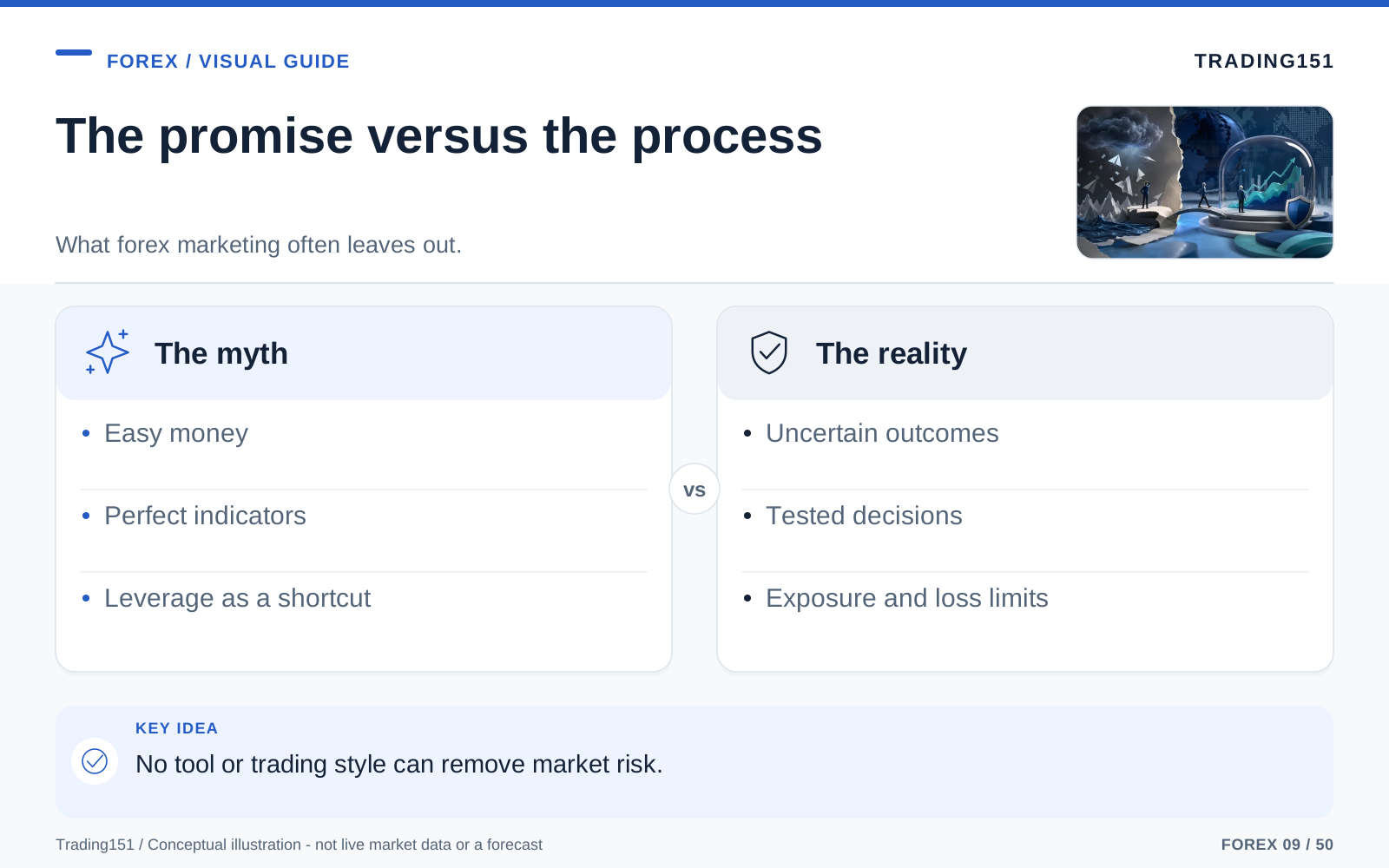
Read this diagram as text
- The myth
- Easy money; Perfect indicators; Leverage as a shortcut
- The reality
- Uncertain outcomes; Tested decisions; Exposure and loss limits
Myth 2: You Need a Huge Amount of Money to Start
The Myth: You need a large bankroll to even bother starting. A tiny account might be cute for practice, but you can't make real money without huge capital unless you take insane risks.
The Reality: You don't need a fortune to start, but you do need a reality check on your expectations.
Thanks to modern retail brokers, getting into the market is easy. You can fund an account with pocket change and use micro-lots to trade tiny positions without risking your life savings. That part is fantastic, especially for beginners.
But istic: you aren't going to turn a $100 account into a six-figure salary in a month without gambling recklessly. A small account is an amazing tool to practice execution, build discipline, and feel the psychological sting of losing real money. It teaches you how to stick to a plan. It will not, however, pay your mortgage right out of the gate.
Starting small is smart. Expecting that small account to solve all your life's problems isn't. Think of your first small account as paying for your education. It lets you make all the inevitable rookie mistakes while the tuition is still cheap.
And sure, prop firms are a huge deal right now, letting traders access larger pools of capital for a fee. But the golden rule still applies: the money will follow the skill, not the other way around.
Myth 3: You have to Win Most of Your Trades to Make Money
The Myth: Good traders win almost all the time. If you’re taking losses, your strategy must suck. The only way to be profitable is to have an high win rate.
The Reality: Being profitable and being "right" are two entirely different things.
This is a large mental hurdle for beginners. Growing up, we’re taught that getting things wrong means we failed. In trading, being right often matters way less than how you handle the math when you win versus when you lose.
A trader who only wins 40% of the time can still pull in consistent profits if their average win is significantly larger than their average loss. It all comes down to risk-to-reward. If you risk $100 to make $300, you don't even need to be right half the time to make money. Your winners simply need to cover your losers and leave a little extra on the table.
Look at the simple math:
- 6 Losing trades at $100 each = -$600
- 4 Winning trades at $300 each = +$1,200
- Net result = +$600
You were wrong more often than you were right, yet you still walked away green.
This is why veteran traders don’t lose sleep over a single bad trade. They think in probabilities and series of trades. A single loss is just the cost of doing business. It only becomes a disaster if you lose your cool and turn one standard loss into three angry, impulsive ones.
Myth 4: The Market Is Rigged Against Retail Traders
The Myth: The market is totally rigged against the little guy. Every time your stop-loss gets hit right before the market reverses, it proves brokers are actively hunting your account.
The Reality: The market isn't out to get you personally, but it is entirely ruthless.
We've all been there. You place a trade, set your stop-loss, and watch the price drop, tap your stop to the exact pip, kick you out, and then immediately shoot in the direction you predicted. It feels like some guy at your broker is watching your screen and laughing.
But what's happening is just market mechanics. Markets naturally gravitate toward liquidity. Big institutional players need someone to take the other side of their large orders. Retail traders have a terrible habit of putting their stop-losses in the same, obvious spots—just below a clean support line, right above a recent high, or right on a round number. That creates a large pool of orders. Price gets magnetically drawn there because that's where the liquidity is.
So no, there isn't a shadowy figure targeting your $500 account. It just means obvious levels get targeted by the smart money. The takeaway? Stop placing your orders exactly where the rest of the crowd puts theirs.
That being said, shady brokers definitely exist. Crazy slippage, weird spreads, and withdrawal headaches are real issues. Do your research and pick a highly regulated, reputable broker. Just make sure you're separating real broker issues from the urge to blame the market every time you take a loss.
Myth 5: You Need to Sit in Front of Charts All Day
The Myth: To be a real trader, you have to stare at charts for twelve hours a day, obsessing over every tick of price action.
The Reality: More screen time doesn't equal better trading. Usually, it just leads to overtrading.
Sure, some trading styles demand intense focus. Scalpers and highly active day traders might spend hours glued to their monitors. But that’s far from the only way to do it, and for most people, it's a fast track to burnout.
Plenty of consistently profitable traders operate on higher time frames. They might look at the charts for thirty minutes in the morning, mark their key levels, set some alerts or pending orders, and then just go live their lives. Their edge isn't speed; it's patience.
One of the biggest traps for beginners is confusing being busy with being productive. If you sit there staring at random 5-minute candles all day, you are going to force trades that don't exist. You'll convince yourself a setup is there just because you're bored. You'll micromanage good trades into bad ones. You'll call it intuition, but really, you're just clicking buttons out of pure restlessness.
A healthy trading routine is often surprisingly boring. And honestly? Boring is profitable.
Myth 6: The More Indicators You Use, the Better Your Results
The Myth: The more indicators you slap on your chart, the better your analysis will be. A professional chart looks like a complex math equation.
The Reality: A cluttered chart usually means you have no idea what's going on.
Don't get me wrong, indicators aren't inherently bad. They can be great tools. The issue is when traders use them as a crutch because they don't understand price action. New traders love to layer on the RSI, MACD, Bollinger Bands, three different moving averages, and a Fibonacci retracement, hoping that if enough lines cross, it’ll guarantee a win.
Newsflash: no amount of indicators can completely erase the uncertainty of the market.
Most of these tools just repackage past price data. They aren't crystal balls. If your chart is screaming five conflicting signals at you at the same time, you haven't done deep analysis—you've just given yourself a headache.
The best traders keep things relatively clean. They rely on market structure, momentum, and key levels. Some use a couple of indicators to confirm their bias; some use none at all. The tool is just there to support the strategy, not be the entire strategy.
If your screen looks like the cockpit of a fighter jet and you still don't know whether to buy or sell, you're doing it wrong. Keep it simple.
Myth 7: Signal Groups and Copy Trading Are the Easy Path
The Myth: You don't need to learn how to trade. Just pay for a VIP signals group or use copy-trading, and let someone else do the hard work.
The Reality: Outsourcing your trading decisions doesn't lower your risk. It just keeps you entirely clueless.
I get the appeal. Why spend years studying charts when some guy on Telegram says he can feed you 90% win-rate signals for $50 a month? But this shortcut almost always ends in tears.
First off, the vast majority of signal sellers are marketers, not traders. Their real income comes from your monthly subscription fee, not the markets. It is easy to cherry-pick winning screenshots, hide large losses, and rent a lifestyle to sell you a dream.
Secondly, even if you find a legitimately good trader to follow, blindly copying them is a nightmare. You'll probably enter late. You might use the wrong lot size. You will definitely panic during a drawdown while they stay completely chill, which means you'll close out for a loss right before the trade turns around and hits their profit target. You aren't copying their mindset; you're just copying their clicks.
This builds a terrible dependency. The second their signals hit a rough patch, you'll jump ship because you have zero underlying conviction. You only start growing as a trader when you fully understand why you're risking your money.
Myth 8: Trading Is Mostly About Strategy, Not Psychology
The Myth: Trading is 90% strategy. Once you find the perfect setup, the rest is just mechanical execution.
The Reality: A solid strategy is the baseline, but your own psychology is what will make or break you.
Trading is intensely uncomfortable. The market has an annoying way of holding up a mirror to your deepest personal flaws. If you lack patience, it’ll cost you. If you have a huge ego and hate being wrong, it’ll cost you. If you have control issues, the market will humble you fast.
A strategy can look absolutely flawless in a backtest, but fall to pieces in a live account because a human being is pressing the buttons. Traders widen their stop-losses because they can't stomach taking a hit. They cash out of winning trades way too early out of fear. They get cocky after a winning streak, double their lot size, and blow the account. Then they revenge-trade to make it back.
This is why veteran traders journal obsessively. And they aren't just writing down entry prices. They are psychoanalyzing themselves. What was I feeling here? Why did I break my rules today? Was I trying to force a trade because I was bored?
Yes, you need technical skills. But if you can't master the emotional side of the game, your technical edge won't save you.
Myth 9: Leverage Is the Key to Making Real Money
The Myth: Leverage is the ultimate cheat code for fast money. If you aren't maxing out your leverage, you're wasting your time.
The Reality: Leverage is a double-edged sword, and beginners usually end up falling on it.
Leverage is exactly why so many people flock to Forex. Being able to control a large position with a couple hundred bucks sounds amazing. And when used responsibly, it’s a great tool. When used recklessly, it will vaporize your account faster than you can blink.
The problem is that leverage amplifies everything. A good trade makes you a lot of money, but a bad trade drains your account just as violently. Because currency pairs usually move in tiny fractions of a cent, beginners vastly underestimate how much damage an over-leveraged position can do when the market spikes against them.
Most blown accounts don't happen because the trader had a fundamentally terrible idea. They happen because they had an okay idea but sized the trade like an absolute maniac. They weren't necessarily wrong about the market direction; they just couldn't afford the wiggle room to be right.
Professional traders always think about survival first. How much can I lose here if I’m wrong? If I lose this trade, can I mentally and financially afford the next one? If your entire strategy relies on hoping the market doesn't reverse, you're using way too much leverage.
Myth 10: Doing Well on a Demo Account Means You’re Ready
The Myth: If you're crushing it on a demo account, you're fully ready for the big leagues. Going live is just the next logical step.
The Reality: Demo trading is crucial, but it completely fails to prepare you for the emotional weight of real money.
Don't skip the demo phase. It’s absolutely essential for figuring out how the platform works, testing out your edge, and getting screen time without setting your wallet on fire. Everyone needs to start there.
But demo trading lacks the one variable that changes everything: real consequences.
It’s unusually easy to hold a losing trade through a large drawdown when it’s Monopoly money. It’s easy to let a winner run to the finish line. Once you fund a live account, your physiology changes. Your heart rate spikes. You start second-guessing your analysis. You desperately want the market to give you a guarantee, and it won't.
This is why the leap from a demo to a live account should be taken in baby steps. The point isn't to prove you can compound fake cash. The point is to learn how to stay emotionally stable when real dollars are fluctuating on your screen. Trading a tiny live account will teach you more about your own psychology in a week than a large demo account will in a year.
A high win rate can conceal a losing strategy
Consider a hypothetical strategy with 80 winning trades that each earn $10 and 20 losing trades that each lose $50. The win rate is 80%, but the gross result is $800 minus $1,000: a $200 loss before costs. The percentage of winners tells you little without the size of the gains and losses.
Reverse the balance. Forty wins of $30 and sixty losses of $10 produce a $600 gross profit across 100 trades. That does not prove the strategy is reliable, because the sample and assumptions still matter. It does show why a low win rate is not automatically disqualifying. Both calculations need actual or realistically modeled spreads, commissions, financing, and slippage before they describe a usable result.
Marketing often hides one of those elements. A service may count closed winners while leaving large losing positions open, or show only its best account. Ask whether returns include unrealized losses, deposits, withdrawals, and every trade. A screenshot of a winning streak is not a complete record.
The more important question is what happens when results depart from the attractive example. Can losses cluster? Can the worst loss be much larger than the historical average? Can execution costs rise? Replacing a myth with a better calculation does not create certainty, but it gives you a clearer basis for deciding which claims deserve further attention.
Ask what a claim leaves out
A screenshot of winning trades may omit open losses, deposits, withdrawn capital, or accounts that were abandoned. Even a genuine result can be presented selectively. Look for the measurement period, the starting balance, the treatment of cash flows, and the risk taken. A claim becomes more informative when it can survive those questions without changing its meaning. Excitement is not a substitute for a complete record. 1, 2
The Bottom Line: Forex Is a Craft, Not a Fantasy
If the social media hype machine has convinced you that trading is a walk in the park, do yourself a favor and drop that illusion right now.
Forex can be rewarding, just not in the cartoonish way it's advertised online. And the real reward isn't just the financial payoff. It’s the competence you build. It’s the patience. It's the ability to look at uncertainty, stay cool, and not let your emotions hijack your mouse. It’s learning how to fiercely protect your capital and stay grounded when the market throws a tantrum.
That kind of personal growth is very real, but you have to earn it.
The traders who survive long-term usually aren't the loudest guys in the room. They aren't flexing screenshots every afternoon or pretending every trade was a home run. They're just quietly executing their edge, accepting that taking losses is part of the job, and trying to get a little better each day.
So, if you really want to dive into Forex, go in with your eyes open. Learn the mechanics. Deeply respect risk. Keep your expectations in check, and start a lot smaller than your ego wants you to. Stop searching for a secret, formula, and spend that time building your own market judgment. The market isn't an ATM; it doesn't owe you a payout just because you showed up.
But if you're willing to treat it like a real profession, Forex can become something way better than an internet fantasy. It can become a genuine craft that you master, which is where real, lasting confidence comes from. Most trading myths only survive because they take a tiny grain of truth and completely ignore the context. Sure, leverage can boost returns, indicators can help visualize data, and anyone can open a small account. But when you factor in real risk, trading costs, and raw human emotion, the picture changes entirely. Proper education strips away the nonsense. The reality of the market might be a lot less glamorous, but it's infinitely more rewarding.
Sources and further reading
Editorial revision: 7 October 2026. Numerical scenarios are hypothetical unless identified as historical. References support the added explanations and selected corrections; rules and product terms should be checked again before acting.