
A forex hedge is intended to reduce a specified currency exposure, not to make uncertainty disappear. It can introduce costs, cash requirements, or a mismatch between the hedge and the obligation. Begin by naming what needs protection, how much it is, and when it matters. Without that, an extra trade may add complexity rather than reduce risk.
What Hedging Means in Forex
At its most basic level, hedging is a risk-management tool. You take one position, and then you open a second one specifically designed to offset the risk of the first.
The goal isn’t to double your profit. Actually, it's often the exact opposite. You’re deliberately giving up a piece of your potential upside in exchange for peace of mind on the downside. That trade-off is the whole point.
It helps to look at a real-world example. Imagine a wheat farmer who’s terrified that crop prices will crash before harvest season. To protect his livelihood, he locks in a selling price ahead of time. If wheat prices tank, his farm survives. If prices rise sharply, sure, he misses out on a large payday, but his business remains stable. That’s hedging.
Forex works exactly the same way, just swap out the crops for currency pairs. If you have a trade open and you're worried about sudden exposure, you can open a secondary position that gains value if your main trade starts to bleed.
Will it always be a perfect one-to-one offset? Rarely. The market moves way too fast for that. But it takes the sting out of sudden volatility spikes, and sometimes a little cushion is all you need to stay in the game.
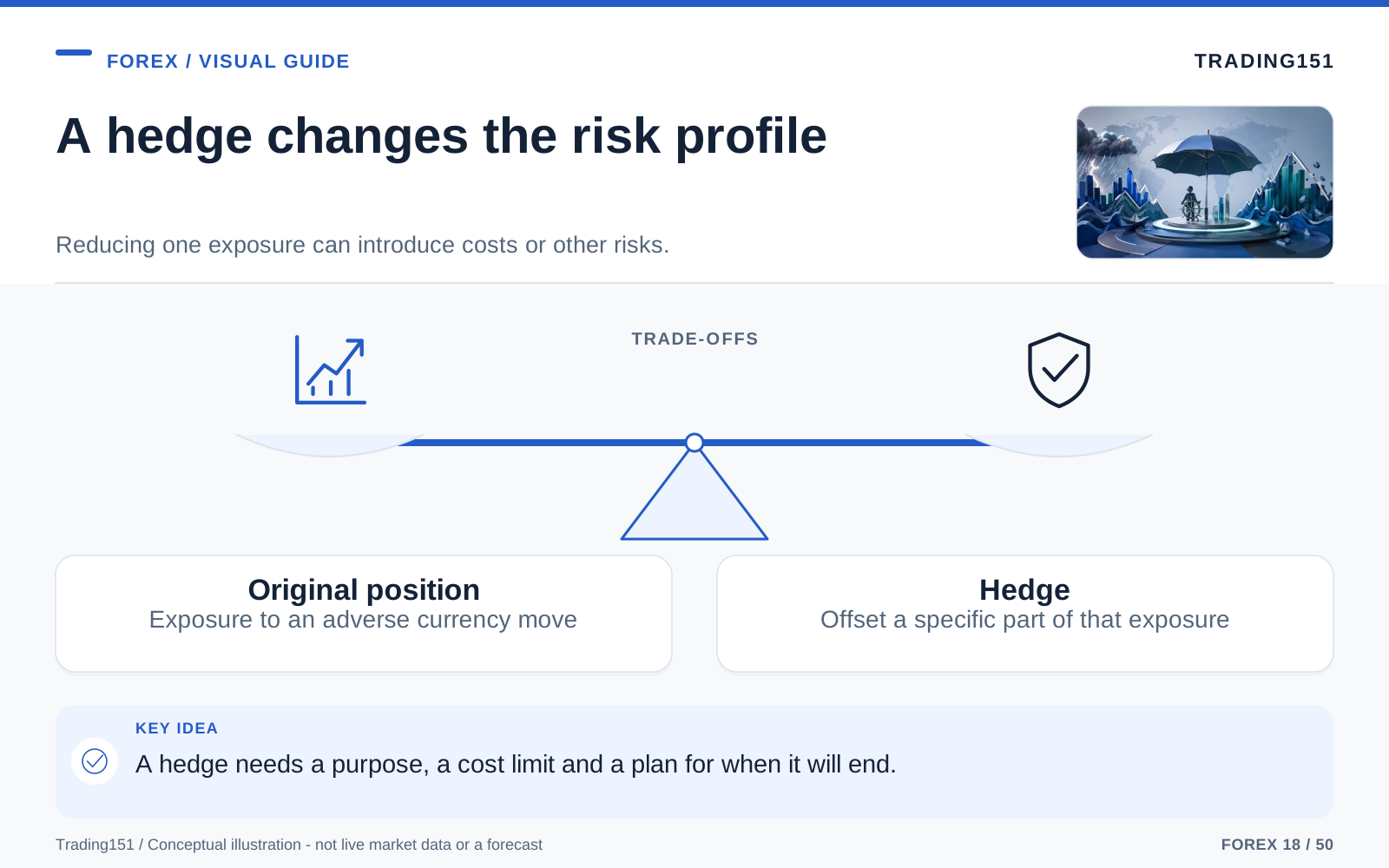
Read this diagram as text
- Original position
- Exposure to an adverse currency move
- Hedge
- Offset a specific part of that exposure
Why Traders Hedge in the First Place
People hedge for a variety of reasons, and —not all of them are smart.
The good reasons are highly practical. Maybe you’re sitting on a swing trade that you still believe in, but there's a large inflation report dropping in an hour and you don’t want to close out completely. Or maybe you realize you're heavily exposed to the US dollar across five different pairs and need to trim that concentration. If you're managing a larger account, you usually care less about squeezing every last pip out of a setup and more about keeping your overall account balance smooth and steady.
Then there are the bad reasons. A lot of traders hedge simply because they can’t stomach taking a loss. They treat it like a psychological escape hatch. Instead of closing a bad trade, they slap on an opposing position and call it "risk management." that’s just fear wearing a clever disguise.
That right there is the crucial distinction. Are you reducing risk, or just hiding from it?
Real hedging is proactive. It has a clear purpose, a specific size, and an exit strategy. Panic hedging is entirely reactive. It usually happens when a trade is already deep in the red and the trader is just desperately looking for a way to stop the pain.
Strategy 1: Direct Hedging
The absolute simplest way to hedge in Forex is the direct approach. You go long on a pair, and then you open a short position on that exact same pair. While holding equal longs and shorts effectively freezes your directional risk, it doesn't solve your original problem. Both sides are still eating up margin, racking up financing fees, and exposing you to spread costs. Plus, you still need to figure out when and how to exit. Without a solid plan, direct hedging just turns one bad trade into two giant headaches.
Say you’re long EUR/USD because you think the euro is gearing up for a run. Later in the day, a major US data release is looming, and you’re worried the dollar might suddenly surge. Instead of closing your long, you open a short EUR/USD position of the same size.
Now you’re playing both sides.
- If EUR/USD rises, your long makes money and your short loses.
- If EUR/USD falls, the short makes money and the long loses.
Assuming the sizes match, you’ve put the trade in a deep freeze. Your floating profit or loss is locked in place while you wait for the news event to blow over.
Why Traders Like It
Psychologically, direct hedging feels great in the moment. It instantly stops the bleeding. If the market is going crazy and you don’t want to make a split-second, emotion-driven choice, throwing on a direct hedge acts like a giant pause button.
It can be handy around elections, surprise news headlines, or central bank rate decisions—any situation where prices whip around violently before picking a real direction.
What Traders Often Get Wrong
The trap here is that a direct hedge only solves your immediate problem: the exposure. It completely ignores the harder question of what you’re supposed to do next.
Eventually, you have to unfreeze the trade. You have to pick a side to close. This is where most traders shoot themselves in the foot. They lock the trade, sigh with relief, and then freeze up. The market starts moving. They panic and close the wrong side. The market reverses again. Now they’ve paid the spread twice, racked up overnight swap fees, and turned a straightforward trade into a tangled, stressful mess.
If you use it deliberately, a direct hedge is a great tool. If you use it impulsively, it’s just a really expensive way to procrastinate.
An Important Limitation for US Traders
There’s also a big regulatory hurdle here. If you’re trading in the US, brokers follow strict NFA rules that essentially ban this kind of same-pair hedging. Under the FIFO (First In, First Out) rule, taking an opposite position will just close out your original trade instead of opening a hedge. So while traders in Europe or Asia do this all the time, US-based retail traders usually have to find workarounds.
Strategy 2: Correlation Hedging With Multiple Currency Pairs
If you can’t (or just don’t want to) hedge the same pair, your next best bet is finding a related one. This is known as correlation hedging. It’s an indirect approach, which means it introduces "basis risk"—the two pairs might be highly related, but they aren’t identical twins. Their reactions to central banks, local news, and overall volatility can drift apart right when you need protection the most. You shouldn't just match your lot sizes blindly; the hedge ratio needs to reflect how the pairs are behaving right now. And even then, it's an educated guess that requires babysitting, not a set-and-forget formula.
Some currency pairs naturally tend to move together, while others move in opposite directions. These relationships aren't set in stone, but they're often reliable enough to build a defensive strategy around.
Using Positively Correlated Pairs
Take EUR/USD and GBP/USD. They aren't perfectly synced, but they usually track in the same general direction because both are heavily bullied by the US dollar.
Let's say you're long EUR/USD and want to dial down your dollar exposure without closing out the trade. One workaround is to short GBP/USD.
If the dollar suddenly flexes its muscles:
- Your EUR/USD long will probably take a hit.
- Your GBP/USD short should theoretically make some money.
It’s not a perfect shield—the euro and the pound have their own local drama to deal with—but it definitely cushions your portfolio against a broad dollar rally.
Using Negatively Correlated Pairs
Another classic setup is EUR/USD and USD/CHF. Historically, these two have a strong inverse relationship. When the euro goes up, the Swiss franc pair goes down, and vice versa.
If you’re long EUR/USD, you could hedge by going long USD/CHF. It feels weird at first—going long on both—but since they usually move in opposite directions, a drop in one should be offset by a rise in the other.
Why Correlation Hedges Appeal to Traders
They offer flexibility. You aren't boxed into locking up a single pair. You can mold the hedge to target the specific risk you're worried about—whether that's a sudden surge in the dollar, weakness in European markets, or a global panic.
It’s also just a much better way to manage a larger book of trades. Instead of obsessing over individual positions, you start managing your overall net exposure.
The Catch: Correlations Aren’t Promises
The biggest blind spot for traders using this strategy is forgetting that correlation is a habit, not a law. It works beautifully right up until the moment it doesn’t.
The euro and pound might hold hands 90% of the time, but a surprise rate hike from the Bank of England can send GBP/USD flying while EUR/USD does nothing. The Swiss franc is a famous safe haven, but a sudden intervention by the Swiss National Bank can flip that relationship upside down in seconds.
Because of this, correlation hedges require active maintenance. You can’t look at a correlation matrix from six months ago and assume it still applies today. You have to trade the market in front of you.
Strategy 3: Hedging With Forex Options
If direct hedges are the simple route and correlation hedges are the flexible route, options are the professional route. They’re cleaner, heavily structured, and sadly, the one tool most retail traders refuse to learn. It’s a shame, really, because options are one of the very few ways to cap your downside without strangling your upside potential. Yes, you pay a premium up front, and the protection eventually expires. Figuring out strike prices, time decay, and implied volatility takes a bit of work. And if you wait until the market is already panicking to buy protection, it’s going to cost you a fortune. Think of it exactly like buying hurricane insurance: you have to buy it while the sun is still shining, accepting that paying those premiums might slightly eat into your long-term returns.
A Forex option simply gives you the right—but not the obligation—to buy or sell a pair at a specific price by a specific date. On the institutional side, this is how real hedging gets done.
How the Insurance Analogy Works
Say you’re long EUR/USD at 1.1000. You love the setup and think it’s going much higher over the next month. But there’s a large ECB press conference tomorrow, and you know the bottom could fall out if the central bank sounds dovish.
You could buy a "put" option that spikes in value if EUR/USD drops below a certain level. If the spot market tanks, your put option steps in to absorb the blow.
- If EUR/USD rallies: Your main trade makes money, and the option quietly expires worthless. The money you spent on it was just the cost of doing business.
- If EUR/USD falls sharply: Your spot trade bleeds, but your option gains value and softens the crash.
Why Options Are Often Called the “True” Hedge
Options separate the protection from the position itself. You don’t have to juggle a second spot trade in real-time. You just pay a flat fee for defined downside protection, leaving your original trade completely alone to do its thing.
That is powerful when you have high conviction in a long-term idea but need to survive a short-term hurdle.
Why Many Retail Traders Avoid Them
Honestly? It comes down to cost and a steep learning curve. Options cost money up front. If the bad event never happens, that money is just gone. A lot of retail traders hate that feeling—it feels like throwing money away.
But that’s how insurance works. You don’t get mad when your house doesn't burn down after paying a year's worth of home insurance. You're just glad you were safe. Options require that exact same mindset shift.
The other hurdle is just comfort. Spot traders love their charts, simple stops, and leverage. Options introduce a whole new language of strike prices, expiration dates, and the "Greeks." It’s not impossible to learn, but it takes a lot more brainpower than just mashing the buy button.
Strategy 4: Safe-Haven Hedging
Sometimes the best way to hedge a currency pair has nothing to do with another currency pair. Sometimes, it’s about moving money into assets that naturally attract terrified capital.
When fear rips through the markets, big money rotates into what we call "safe havens." In the macro trading world, the heavy hitters are usually:
- Gold (XAU/USD)
- The Japanese yen (JPY)
- The Swiss franc (CHF)
Let's say your account is loaded up with growth-sensitive pairs like AUD/USD or NZD/USD. These trades thrive when the global economy is humming, commodities are hot, and investors are feeling brave.
But the second panic sets in, those currencies get dropped like a bad habit. To hedge against a sudden shift in market mood, you could take a position in something that thrives on fear—like gold or the yen.
If the market suddenly tanks, your risk-on currencies will take a hit, but your safe-haven asset should theoretically catch a bid and offset the damage.
Why This Works Well in Practice
It works because it tracks actual human behavior. The markets aren't just a bunch of technical lines on a chart; they're driven by greed and fear. When investors get spooked, they seek shelter. A safe-haven hedge is just betting on that primal instinct.
Why It Still Requires Judgment
Safe havens aren’t an automatic cheat code. Gold doesn't always rocket up the second the stock market blinks. The yen might catch a safe-haven bid, but domestic interest rates could completely mute the move. The Swiss franc loves a good panic, but the SNB is always lurking in the shadows to prevent it from getting too strong.
It’s a great macro strategy, but it requires situational awareness. You have to understand what kind of storm is brewing, and whether the specific safe haven you're buying makes sense for the current environment.
What Hedging Costs You
The idea of a perfectly hedged, risk-free portfolio sounds amazing in theory, until you look at the receipt. Hedging is not free. The financial costs are real, and the mental toll is often worse. You have to weigh the cost of the hedge against the actual risk it’s removing. If you're paying to hedge a tiny, short-term dip but leaving your main exposure wide open, you're getting a terrible deal. You have to calculate your net exposure, factor in the spreads and overnight fees, and know exactly how long you plan to hold it. If you can’t name the exact event you’re protecting against and the exact moment you'll close the hedge, you aren't adding safety—you're just adding chaos.
Spreads and Commissions
Every time you open a new position, you pay the toll. You pay the spread on entry, and depending on your broker, you might get hit with commissions, too. If you make a habit of flipping hedges on and off, those "tiny" costs will chew through your account balance surprisingly fast.
In your head, you’re being a tactical genius. In your account history, you're just racking up fees.
Swap and Carry Costs
If you hold trades overnight, swap rates matter. In fact, it’s one of the most painfully misunderstood parts of hedging.
A trader will look at their screen and think, "I’m long and short the same size, so I’m totally flat." On the chart? Sure. But in your balance? Not at all. Brokers don’t design swap rates to make your life easy. You might be paying a large fee on the short side while earning pennies on the long side. Hold that hedge for a few weeks, and you’ll slowly bleed out even if the market price never moves.
Opportunity Cost
Protection is a compromise. If your hedge works beautifully, it will save you from losses. But it’s also going to act as a drag on your profits. That’s the deal you make. A smoother ride means a less explosive destination.
There is absolutely nothing wrong with that, as long as you're doing it on purpose. Traders will often whine that a hedge "killed their profits," forgetting that limiting the P/L swings was the entire point.
Mental Clutter
This rarely gets talked about, but it's large. A hedge might make your margin safer, but it clutters your brain. One simple trade turns into two. A clear thesis turns into a juggling act. Suddenly, you're managing a web of intertwined positions instead of just reading price action.
If you planned for it, you can handle the complexity. If you improvised it in a panic, it’s going to drive you crazy.
When Hedging Helps and When It Usually Doesn’t
Hedging really shines for traders who hold positions for days, weeks, or months. Swing traders, position traders, and portfolio managers get real value out of it. They use it to ride out nasty news events without abandoning a core thesis, or to trim their exposure without liquidating a great entry.
But if you’re a short-term trader? Hedging is almost always more trouble than it’s worth. If you’re day trading or scalping, the absolute best risk management tool is still the one nobody likes to use: a hard stop loss.
It’s not sexy, but it’s true. Taking a small, disciplined paper cut and moving on is infinitely better for a day trader than building a complex, expensive hedge just to avoid being wrong.
The Psychology Behind Hedging
This is the most important part of the entire discussion. The math and the mechanics are easy enough to learn. The hard part is looking in the mirror and being honest about why you are hedging.
When used correctly, hedging is a mark of a mature trader. It shows you respect the unknown. You accept that the market can do whatever it wants, and you are willing to pay a small premium to protect yourself from the worst-case scenario.
When used poorly, hedging is just outright denial. A trader doesn't want to swallow a loss, so they open a second trade to numb the sting. At that point, they are no longer managing an account—they are negotiating with their own ego.
That’s exactly how the death spiral starts. One bad trade becomes two. Then a third trade is opened to "fix" the second one. Before they know it, they aren't even trading the market anymore; they're just desperately trying to untangle the mess they built.
Professionals plan their hedges before the pressure arrives. Amateurs slap on hedges after the panic sets in.
Never forget the difference.
Practical Rules for Hedging Without Making Things Worse
Hedging is only a weapon if you handle it with discipline. Here are a few ground rules to keep you out of trouble:
- Know exactly what you’re hedging. Are you dodging a central bank speech, reducing dollar exposure, or protecting a specific entry? If you can’t name the threat, don't hedge it.
- Plan it before you need it. The best defensive moves are decided with a cool head, not improvised while your screen is flashing red.
- Size it right. A hedge that’s too small is useless. A hedge that’s too big can accidentally flip your direction entirely.
- Count the costs. Spreads, negative swaps, and option premiums need to be baked into your plan, not discovered as an ugly surprise later.
- Have an exit strategy. The hedge isn’t finished until you know exactly when and how you’re going to take it off.
- Don’t use it to hide from a bad trade. Sometimes the smartest, most profitable thing you can do is just close the position, take the hit, and start fresh tomorrow.
A hedge needs a defined exposure and an end date
Suppose a business expects to pay EUR 50,000 in three months while its cash is held in dollars. The relevant exposure is the dollar cost of that future euro payment. A hedge can be assessed against that obligation. If the amount or payment date changes, the original hedge may no longer match, so the business needs a procedure for reviewing it.
Contrast that with a trader who opens an equal and opposite position in the same currency pair after a loss. Under some account structures the trades may offset; under others they may remain as separate positions. Either way, gross positions can still create spreads, financing, and administrative complications. Holding both directions does not recover the existing loss by itself.
Measure what risk remains. A partial hedge reduces sensitivity without removing it. An option may provide a right rather than a fixed obligation, but the premium is a cost. A forward or futures hedge can create collateral or cash-flow requirements before the underlying commercial payment occurs. The appropriate tool depends on the objective and contract.
Record the reason for the hedge and the conditions for reducing or removing it. Otherwise a protective position can linger after the exposure disappears and become speculation in its own right. A successful hedge may lose money on the contract while protecting the underlying obligation; evaluating only that contract's profit would miss its purpose.
Hedge the amount and date that are reasonably known
A business expecting a foreign-currency receipt should distinguish a signed obligation from a possible future sale. Hedging money that never arrives can leave a new exposure rather than remove one. The timing matters as well: a delayed invoice may not match the hedge's settlement date.
Keep the commercial forecast and hedge records connected. Review changes in expected amounts, payment dates, and cancellation rights. A hedge should serve the underlying cash flow, not become a separate speculation that survives after the original transaction has disappeared. The appropriate structure depends on how certain that cash flow really is. 1, 2
So, Is Hedging Worth It?
Absolutely. In the right hands, and for the right reasons, hedging is one of the most powerful risk-management tools you can master. It smooths out the concerning swings in your equity curve, lowers your blood pressure, and lets you hold onto great setups even when the market throws a tantrum.
But it isn’t magic. It won’t fix a terrible entry. It won’t save you from overleveraging. It doesn't make risk vanish into thin air. It simply changes the shape of your risk. Sometimes that’s exactly what your portfolio needs. Other times, it just burns cash and clouds your judgment.
The healthiest way to look at hedging is this: it’s a shield, not an eraser.
If you hold trades through major news, juggle correlated pairs, or prefer a stable equity curve over chasing large, risky wins, hedging definitely belongs in your playbook. If you’re a sniper taking quick intraday setups with tight stops, you might never need to touch it.
The fundamental truth of trading is that the market will inevitably test your resolve. Hedging won’t prevent the test, but it can absolutely help you stay calm and rational when the moment arrives.
And in Forex, surviving those moments is everything. The traders who make careers out of this aren’t the ones who magically sidestep every drawdown. They’re the ones who know how to weather the storm without blowing up their accounts, without second-guessing their every move, and without lying to themselves about the risks they’re taking.
That’s what a proper hedge provides. It doesn’t make trading easy, but it makes it survivable, manageable, and just a little bit quieter when the charts go crazy. Sometimes the best "hedge" is just cutting your size in half or walking away entirely. But when you have exposure you can't easily drop, or an event you just need to bridge, a calculated hedge is invaluable. It should be an answer to a specific question. If you're just using it because you don't want to admit a trade is a loser, you're only delaying the inevitable—and making it a whole lot more expensive.
Sources and further reading
- CFTC: Eight things to know before trading forex
- BIS: April 2025 FX turnover, September 2025 preliminary release
Editorial revision: 7 October 2026. Numerical scenarios are hypothetical unless identified as historical. References support the added explanations and selected corrections; rules and product terms should be checked again before acting.