
A carry trade seeks to benefit from a funding or interest-rate difference between currencies, but its return still depends on exchange rates and the terms of the position. The rate difference is not a guaranteed income stream insulated from price risk. Understanding how carry is credited, charged, and potentially overwhelmed by currency movement is essential.
What Exactly Is a Carry Trade?
Let's ignore the trading platform for a second. Think like someone taking out a loan.
Imagine you can borrow cash in one country for practically nothing—say, 0.5% a year. Meanwhile, a neighboring country is paying out 5% on deposits. If you borrow the cheap money, convert it, and park it in the high-yield account, that gap is your "carry."
To break it down:
- You borrow where it’s inexpensive.
- You park that money where it grows faster.
- You pocket the difference, hoping the exchange rate doesn't tank while you're holding it.
That last part? That's the catch. People love to call the carry trade "getting paid to wait," which is technically true, but it breeds a false sense of security. Yes, the interest income is real. But the currency risk is just as real. If the high-yielding currency suddenly drops in value, your steady little income stream gets wiped out in an instant.
On a forex platform, you play this out through a currency pair. You go long on the currency with the higher rate and short the one with the lower rate. If you're on the right side of the math, your broker drops a little credit into your account for every day you hold the trade overnight. That daily payout is the hook that draws people in.
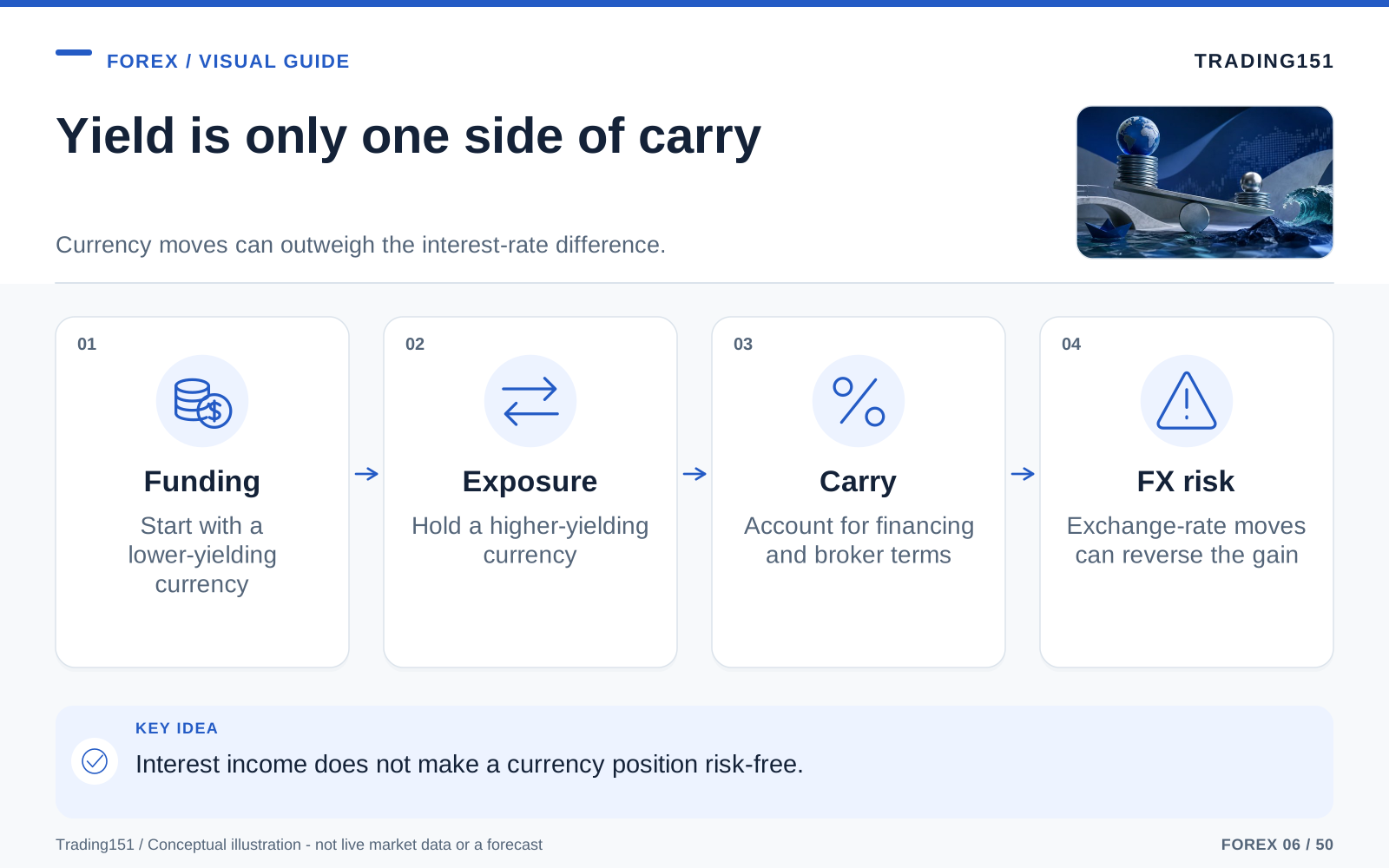
Read this diagram as text
- Funding
- Start with a lower-yielding currency
- Exposure
- Hold a higher-yielding currency
- Carry
- Account for financing and broker terms
- FX risk
- Exchange-rate moves can reverse the gain
How the Strategy Makes Money
The mechanics aren't a secret, even if brokers love burying them under jargon like swap, rollover, or tom/next financing.
Every time you hold a forex position past the daily cutoff time, your broker adjusts your trade based on the interest-rate gap between those two currencies. If you bought the high-yield currency and sold the low-yield one, you usually get a tiny positive credit. If you did the opposite, you pay a fee.
Basically, the market is quietly settling the tab for holding one currency against another overnight.
For a day trader, swap rates are completely irrelevant. But for a carry trader, the swap is the whole reason they showed up.
Let's say the rates are in your favor. After your broker takes their cut, you earn a few bucks every night. One day of swap doesn't feel like much. A week still feels pretty small. But let it ride for a few months? Now we're talking. The strategy isn't about adrenaline; it’s about extreme patience.
It also messes with your head in a good way. Most trading styles demand that you’re right immediately. The carry trade pays you to sit on your hands and wait for a bigger economic trend to unfold.
The Important Detail Most Beginners Miss
When beginners hear "interest income," they assume they've found a passive income cheat code. They haven't. Your total return is the swap plus the actual movement of the currency pair. You can earn carry every day and still blow your account if the spot price tanks. And trust me, a crashing exchange rate will eat your account way faster than your daily pennies can save it. Swap is just a bonus; it’s never enough to rescue a fundamentally bad trade.
So, you've got two things happening at once: the interest you’re earning, and the actual price of the pair on the chart.
If you’re pulling in 4% or 5% a year from the interest rate gap, but the pair itself drops 12%, you’re losing money. Carry can act as a nice buffer, and in a winning trade, it juices your returns. But it won't save you if the market turns against you. The exchange rate always drives the bus.
That’s why the pros don’t use carry as an excuse to skip doing their homework. They look for good technical setups and strong economic trends, and then they use the carry as the cherry on top. The best setups aren’t just about high yields—they require a solid trend, a stable global economy, and a narrative that makes sense.
The Role of the "Swap" in Everyday Trading
If you’ve ever accidentally left a day trade open overnight, you’ve probably experienced swap, even if you didn't know what to call it. But don't assume the swap your broker charges is just a clean math equation based on central bank rates. It includes broker markups, overnight funding costs, and weird settlement rules. Rates can fluctuate without warning, so you always have to check your platform's specs rather than just Googling a country's interest rate.
When you wake up, your platform might show a tiny positive or negative balance adjustment. Sometimes it’s just pennies and easy to ignore. Other times, depending on the pair, it can make or break the viability of your strategy.
Keep these three practical things in mind:
- Brokers are substantially different. You can trade the same pair on two different platforms and get completely different swap rates because of how they structure their fees.
- Rates aren't set in stone. Central banks change their minds, and brokers adjust their funding rates to match.
- Wednesdays are weird. Because of how weekend forex settlements work, the swap you pay (or earn) on a Wednesday is often tripled. It can catch you off guard if you aren't expecting it.
Bottom line? Don't blindly trust a central bank rate chart. Look at what your specific broker is paying out for the exact pair you're trading.
Why the Carry Trade Became Famous
Carry trading isn't new, but it really had its moment in the spotlight when global interest rates were all over the place and the markets were unusually quiet. Those were the golden years for this strategy. You could just put on a trade, walk away, and watch the income roll in.
The ultimate classic was the Japanese Yen. Japan kept its interest rates pinned near zero for years, making the yen the ultimate cheap money to borrow. Traders would borrow yen and use it to buy higher-yielding currencies like the Aussie or Kiwi dollar.
As long as the global economy was chugging along happily, it was a no-brainer. Why hold cash that pays zero when you could borrow it for nothing and dump it into an asset paying a solid yield?
It was a large opportunity that attracted everyone from large hedge funds to weekend retail traders.
The Story of Mrs. Watanabe
You can't really talk about the history of this strategy without bringing up Mrs. Watanabe. It was a nickname given to Japanese retail traders who basically became the face of the carry trade.
The nickname is a bit of an industry myth now, but it was born from a very real frustration. For years, Japanese savers were getting absolutely zero return on their domestic bank accounts. So, normal people started looking overseas. They began selling off their yen to buy foreign currencies that paid a decent yield, using regular retail forex accounts to do it.
What made it such a huge story was the demographic. The financial media wasn't talking about slick Wall Street financial professionals; they were talking about everyday homemakers managing the family budget, ruthlessly exploiting global interest rate gaps with intense discipline.
Whether the "Mrs. Watanabe" stereotype was entirely accurate doesn't really matter. It proved a point: carry trading wasn't just for institutional quants anymore. It had gone mainstream.
And it highlights a very human truth about money. It doesn't take an economics degree to realize that if your cash is doing nothing at home, you should move it somewhere it goes to work.
What Makes a Good Carry Trade Setup?
Just because a pair pays you overnight swap doesn't mean it’s a good trade. In fact, a lot of positive-swap pairs are absolute traps. A good setup needs a few things to line up perfectly.
1. A Meaningful Interest-Rate Differential
The payout has to be worth the headache. If the rate gap is tiny, your broker’s spread and random market chop will eat whatever you make. You want a fat, obvious difference in yields.
This is why pairs involving the Yen (like AUD/JPY or NZD/JPY) or exotic emerging-market currencies are so popular. The contrast is stark: one side is practically free to borrow, and the other pays out nicely.
2. Relative Price Stability
This is probably more important than the yield. A good carry trade is boring. You want a market that is either slowly grinding higher in your favor or just moving sideways.
Wild, aggressive price swings will ruin your day. What’s the point of collecting two dollars a day in swap if the pair is plummeting hundreds of pips a week?
3. Supportive Macro Conditions
Carry trades need a confident, happy market. Investors have to feel safe enough to buy riskier assets. That usually means inflation is chill, the economy is growing, and there aren't any large crises breaking out.
When people get scared, they dump their risky, high-yield stuff and rush back to safe, boring funding currencies. When that happens, carry trades get violently dismantled.
4. Clear Central-Bank Divergence
The absolute best setups happen when two central banks are fighting totally different battles. If one is desperately raising rates while the other is committed to keeping them on the floor, you've got a great story. Markets love a clear contrast.
The Real Fuel Behind Carry Trades: Risk Sentiment
We talk a lot about interest rates, but the secret engine driving the carry trade is pure emotion—specifically, confidence. When times are good, everyone piles into the same yielding pairs. But the second panic sets in, everyone rushes for the exit at exactly the same time. The funding currency spikes, the high-yield currency crashes, and a slow-burn strategy suddenly explodes into a highly volatile nightmare.
When the market is in a "risk-on" mood, traders feel brave. They happily borrow cheap, safe currencies to buy riskier, high-paying ones. Capital flows freely, and carry trades just drift upward beautifully.
But when a "risk-off" mood hits, the party ends. Traders start slashing their leverage, dumping high-yield currencies, and scrambling back to safety. At that point, nobody cares about collecting an extra 4% a year; they just want to survive.
This kind of sudden panic can be triggered by almost anything:
- A sudden banking crisis
- A random recession scare
- Geopolitical tension or war
- A central bank shocking the market
- A severe day on the stock market
- Credit markets freezing up
Once the panic starts, it snowballs. The traders who were just serious and collecting swap yesterday are suddenly panic-selling to cut their exposure. And because so many of these trades are highly leveraged, the exits get really ugly, really fast.
The Dark Side of the Carry Trade
We have to talk about the risks, because they are large.
The carry trade is famously sneaky. It will give you a tiny, reliable payout every day for months, tricking you into feeling like a genius. And then, out of nowhere, one horrific drop wipes out six months of gains in an afternoon. There’s a reason old-school traders compare it to picking up pennies in front of a steamroller. Yes, you get the pennies. But you also get flattened.
It always follows the same script. The market gets lazy. Volatility dies down. The strategy looks foolproof, so traders start increasing their position sizes. Then, a random news event hits, and suddenly everyone tries to squeeze through the same exit door at once.
Safe-haven funding currencies like the Yen or the Swiss Franc explode higher because everyone has to buy them back to close their trades. The high-yield currencies they were holding plummet. All those little swap payments you bragged about suddenly look completely pathetic compared to the giant red number on your screen.
This is why veterans respect the strategy but never fully trust it. Carry trades are great, but never mistake "slow" for "safe."
Why Leverage Turns a Smart Idea Into a Bad Trade
Leverage is exactly how retail traders manage to screw this up. Because the daily swap payment is so small, people get greedy and crank up their position size to make it feel worthwhile. Don't do it. A normal market pullback on a large position will trigger a margin call long before the swap makes you rich. Size your trade for the worst-case scenario first, and treat the swap as a nice little bonus.
The temptation is huge. You think, "If I'm guaranteed this swap every night, why not crank up my leverage and make real money?" The answer is simple: because currency markets breathe. They go up, they go down. And a bigger position means you have no breathing room.
Carry trading is a marathon. By using crazy leverage, you force it to be a sprint. A totally normal 50-pip pullback suddenly puts your account in danger. You end up having to close the trade just to survive, missing out on the long-term income you wanted.
Keeping your leverage low isn't just generic trading advice here; it’s the only way the strategy functions. Small sizing buys you the time you need to let the swap accumulate.
Good traders would rather hold a tiny position for eight months than a large one for eight days. It sounds boring, but if you're carry trading, boring is the whole point.
How to Approach a Carry Trade Like a Professional
You don’t need to work at a major bank to pull this off, but you do need rules. The most important work happens before you even click "buy."
Step 1: Watch the Central Banks
You can't just casually glance at interest rates. Central bank policy is the entire heartbeat of this strategy.
Figure out who is keeping rates low and who is promising higher returns. But don't stop there—look at the horizon. Are those rates going to stay put? Is one country hinting at a rate cut soon?
A juicy swap rate today means absolutely nothing if the central bank is planning to slash rates next month. The market will price in a change long before the bank pulls the trigger.
Step 2: Respect the Chart
The economic story might sound amazing, but if the chart looks like garbage, don't take the trade.
You want to see the pair trending nicely in your favor, or at least chopping sideways in a tight range. The absolute dumbest thing you can do is buy into a large downtrend just because the swap is positive. The trend will crush you every time.
Step 3: Keep Position Size Modest
I'm saying this again because it’s that important. Trade small enough that a bad week doesn’t give you a panic attack. If a routine dip makes you sweat, your position is too big.
Step 4: Be Patient With Entry
You don't have to FOMO into a carry trade. If the pair just had a large run-up, let it cool off. You don't need a picture-perfect entry, but you also shouldn't start a long-term waiting game with a rushed, emotional click.
Step 5: Plan Your Exit Before the Market Forces One on You
Because these trades feel so comfortable, it's easy to fall asleep at the wheel. Don't. Figure out your line in the sand before you enter. What breaks the setup? A trend line break? A surprise inflation report? A stock market crash?
Have a rule for when to walk away, so you don't end up making a panicked decision when the market starts crashing.
A Simple Hypothetical Example
Let’s say we’re in an environment where one central bank has rates at 5% and another is glued to 0%. You find a pair that tracks this gap and pays you a positive swap to go long.
You buy in with a sensible position size. It’s small enough that a sudden drop will be annoying, but won't blow your account. Every night, your broker drops a little cash into your balance. Somedays the chart goes up, somedays it goes sideways, and somedays it dips and tests your nerves.
If everything goes according to plan, you make money in two ways:
- Carry income from the daily swap credit.
- Capital appreciation if the chart moves higher.
That’s the ideal. You're getting paid to wait while the trend does the heavy lifting.
Now imagine the flip side. A global crisis hits out of nowhere. Everyone panics and unwinds their trades. The pair drops like a rock. Yes, you're still getting that cute little overnight swap, but it doesn't even come close to covering the large chunk of capital you just lost on the chart.
That’s the reality of the carry trade. The daily income is great, but the actual price of the currency pair will always dictate whether you win or lose.
The Psychology Behind the Strategy
On paper, this is the most relaxing way to trade. In reality, it will drive you insane.
As traders, we are wired for action. We want the flashing lights, the quick profits, the dopamine hit of closing a winning trade. Carry trading deprives you of all of that. It demands that you think in quarters and years, not minutes and hours.
And honestly? A lot of people just don't have the mental wiring for it.
You have to get really comfortable being bored. You have to tune out the daily market drama. You have to accept that your trade might do absolutely nothing for three weeks straight. Above all, you have to trust your initial analysis so much that you don't impulsively close a great trade just because you're itching to do something.
There’s also a really dangerous mental trap: because the trade is just slowly dripping income into your account, you start treating it like a high-yield savings account instead of a volatile market position. That’s when you get sloppy. You move your stop loss further away. You ignore bad economic news. You tell yourself, "It’s fine, I'll just hold on and collect the swap until the price bounces back."
That exact mindset is how a slow, conservative strategy turns into a total disaster.
When You Should Avoid the Carry Trade Entirely
Sometimes the best thing you can do is just sit on your hands and wait.
1. When Central Banks Are About to Pivot
If the country paying the high yield is about to start cutting rates, do not get in. The market is forward-looking. By the time the guy at the podium announces the cut, the chart has already moved. You only want to carry trade when the interest rate story is boring and stable.
2. When Global Fear Is Rising Fast
This strategy despises panic. If the news is dominated by failing banks, recession alarms, or large stock market crashes, carry trades become fragile. When people are scared, they don't care about a 5% yield—they care about not losing all their money.
3. When Volatility Is Expanding
When the market starts violently whipping back and forth, the math completely changes. That tiny swap payment looks pretty pathetic when the currency pair is suddenly moving 150 pips a day. A trade that felt safe in a sleepy market becomes a total nightmare in a volatile one.
4. When You’re Trading for Income but Emotionally Watching Every Tick
This one is entirely on you. If you know deep down that you can't walk away from your screens without checking your P&L every ten minutes, this isn't for you. Carry trading requires genuine patience, and you can't fake that.
Practical Mistakes Traders Make Again and Again
When these trades fail, it’s rarely because the market did something impossible. It's almost always because the trader made a completely avoidable error.
- Assuming central bank rates equal broker swap: Traders just google a country's rate and assume their broker will pay that exact amount. They often don't.
- Maxing out the leverage: The absolute classic mistake. The trade gets stopped out long before the strategy can even work.
- Fighting a large downtrend: Buying into a crashing market just because the swap is positive is a guaranteed way to lose money.
- Getting tunnel vision on the yield: The swap rate is only one piece of the puzzle. If you ignore inflation, market sentiment, and global growth, you're flying blind.
- Falling in love with the trade: A carry trade only makes sense as long as the economics support it. When the story changes, you have to leave.
None of these are substantially complex mistakes. But they are common, totally human, and dangerously easy to justify in the moment.
So, Is the Carry Trade Worth It?
Yes, if you catch the right market environment. Absolutely not, if you think it's a magic money creation.
It works beautifully when you treat it as just one tool in a larger macro strategy, rather than a lazy hack for free cash. When the rate gap is wide, central banks are behaving predictably, the chart looks healthy, and the market is calm, it is unmatched. You're placing a bet on a direction, and you're getting paid while you wait to be proven right.
When the price action and the daily swap are working together, the returns can be phenomenal.
But you have to leave your ego at the door. Markets are fickle. Central banks pivot. Sentiments crash. If you're going to trade this way, you have to be totally willing to look at a trade you loved three months ago and admit, "Yeah, this doesn't make sense anymore."
A few days of price movement can outweigh months of carry
Suppose a hypothetical currency position earns net carry equivalent to 4% a year before other costs. Over three months, that is roughly 1% using a simple approximation. A 3% adverse exchange-rate move over the same period more than offsets it. With leverage, the effect on the cash committed to the position is larger still. The attractive annual rate does not protect the principal from a much faster price adjustment.
For a retail rolling position, the amount credited or charged is determined by the broker's financing terms, not simply by subtracting two central bank policy rates. Funding markets, markups, the contract, and holiday adjustments can affect the result. A quoted positive rate can change. Verify the actual terms for the pair and direction rather than assuming the higher-yielding currency always produces the expected credit.
Keep a separate record of trading profit or loss, financing, and commissions. Otherwise, an apparently successful carry position may be a directional trade that happened to rise, while an apparently unsuccessful one may have incurred much higher financing costs than planned. The distinction matters when deciding whether the original idea worked.
A useful stress test asks how far the exchange rate could move before a year of expected carry is erased. Then ask whether the account can tolerate that move without forced closure. That puts the slower income stream and the faster market risk on the same page, where they belong.
A small yield advantage can meet a large currency move
A carry position should be evaluated as a combined return: interest or financing received, exchange-rate movement, and costs. A favorable rate difference does not prevent the borrowed currency from strengthening. Stress-test the exchange-rate change that would erase several months of carry, then consider whether the position could be held through that move. The advertised yield is only one part of the exposure. 1, 2
Conclusion: The Carry Trade Is a Strategy for Adults
Carry trading is one of the most fascinating corners of the forex market because it rewards the one trait nobody ever seems to care about: restraint.
It’s not sexy. You don't get the instant dopamine hit of a fast day trade. No one on social media is going to care about a screenshot of your tiny overnight swap credit. But there's a reason institutional traders have used it for decades. It's grounded in real-world economics—specifically, how different countries value their money.
At its absolute best, it’s a hyper-disciplined way to ride major global trends while adding a second income stream to your trade. At its worst, it’s a lazy gamble by traders who get so focused on yield that they don't notice the market is about to drop the floor out from under them.
The traders who survive and profit from this strategy share a few boring but vital habits: they watch the central banks, they respect market sentiment, they keep their leverage low, they pick their pairs wisely, and they never, ever mistake "slow" for "safe."
That’s what real patience looks like in this game. It’s not about just sitting there doing nothing. It’s about knowing exactly when the tide is bringing money your way, and having the common sense to step back the second the water gets too rough.
Before you put your money on the line, run through a mental checklist: understand the central bank's next move, check the volatility, know exactly what your broker is paying, and figure out your exit plan before things go sideways. Because the second the market decides the carry trade is over, it doesn't give you a polite warning—it just aggressively takes your money.
Sources and further reading
- CFTC: Eight things to know before trading forex
- BIS: April 2025 FX turnover, September 2025 preliminary release
Editorial revision: 7 October 2026. Numerical scenarios are hypothetical unless identified as historical. References support the added explanations and selected corrections; rules and product terms should be checked again before acting.