
A dividend is a distribution from a company to its shareholders. It can provide useful income, but receiving it does not make an investor wealthier by the full payment regardless of what happens to the shares. Total return includes both the cash received and changes in share value. That is the right starting point for evaluating a dividend strategy.
What Dividends Are
To really get dividends, you have to remember what a stock is. It’s not just a blinking ticker symbol on your phone. It’s a literal piece of ownership in a living, breathing business. When you buy shares, you're buying a stake in that company’s future profits, its growing pains, and its ultimate success or failure.
Think about it like helping a friend open a local coffee shop. Let’s say the place kills it. After paying the baristas, buying the beans, covering rent, and setting aside a cash cushion for a rainy day, there’s money left over. Your friend has options. They could stash it all in the bank, open a second location, or—since you helped bankroll the place—they could hand you your share of the profits.
That right there is a dividend.
Public companies do the same thing, just on a large scale. A mature company—maybe one selling soap, insurance, software, or electricity—usually churns out more cash than it needs to run its day-to-day operations. When the people running the show feel financially secure, they distribute some of that excess cash back to the owners.
So when that money hits your brokerage account, it’s not a bonus or a gift. It’s your rightful cut of the profits. You didn't have to work the assembly line, deal with angry customers, or negotiate contracts. You just owned a piece of the pie.
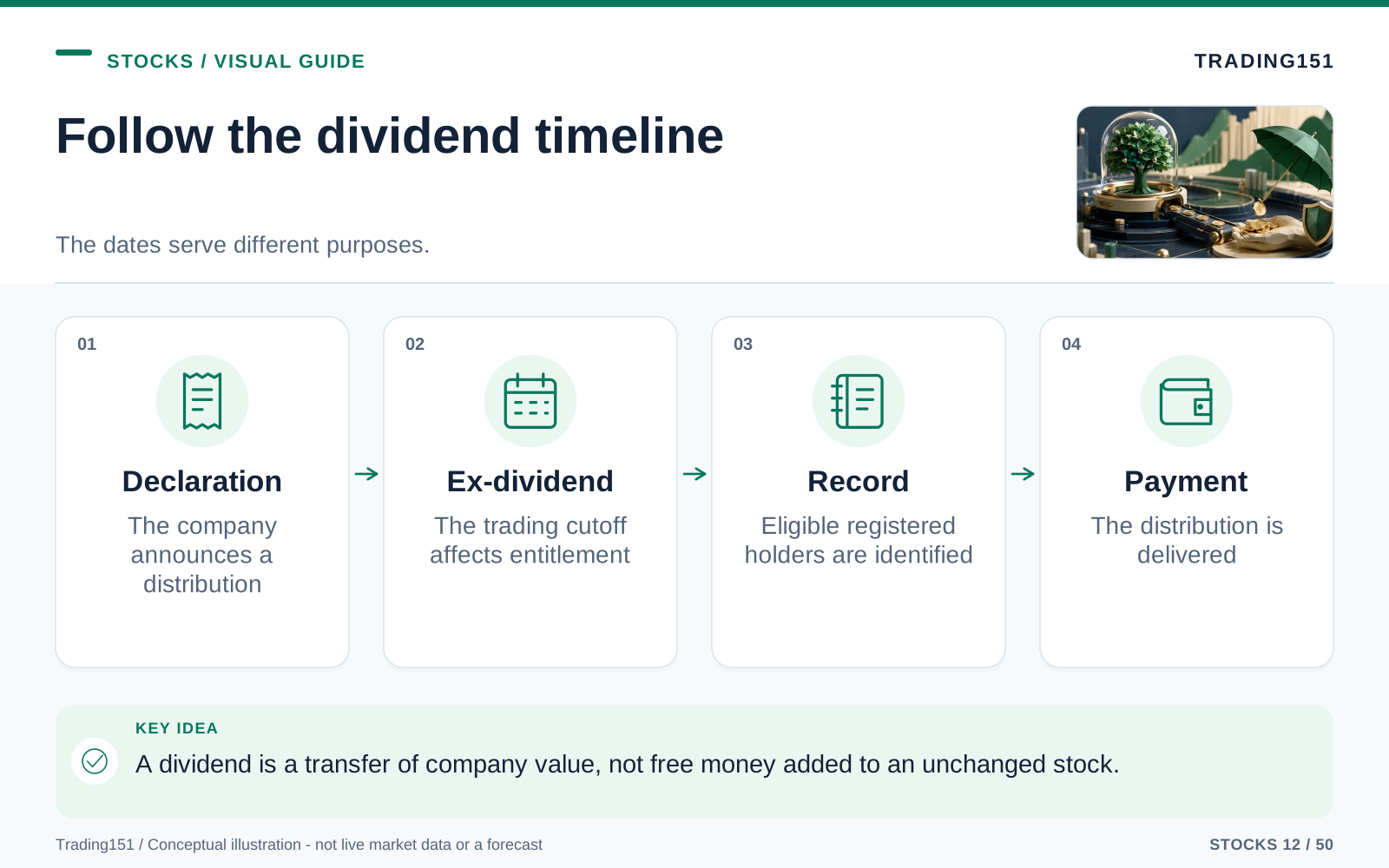
Read this diagram as text
- Declaration
- The company announces a distribution
- Ex-dividend
- The trading cutoff affects entitlement
- Record
- Eligible registered holders are identified
- Payment
- The distribution is delivered
Why Companies Pay Dividends in the First Place
Keep in mind, companies aren’t forced to pay dividends. Plenty of them keep every dime they make because they believe they can reinvest it to grow the business faster. You see this a lot with young tech startups. They want to pour cash into research, hire top talent, and take over their market. That’s perfectly fine—aggressively reinvesting profits is how small companies become giants.
But dividend-paying companies are usually in a different phase of life. They’re established, profitable, and their growth has stabilized. They might still be expanding, but they don’t need to burn through every spare dollar to do it. Paying a dividend is basically a company's way of saying, "We're doing well enough to share the wealth."
As an investor, getting that regular cash drop is a large relief. The stock market is notoriously moody. Prices swing substantially based on interest rates, scary news headlines, or just the general vibe of the day. Dividends don’t stop those wild swings, but they do give you a different way to measure your success. Instead of stressing over whether your stock is in the red this week, you can zoom out and ask: Is the business still profitable? Is my dividend safe? Is my income growing?
The Two Ways Stocks Can Make You Money
Most people only know one way to play the stock market: buy low, sell high. That’s called capital appreciation. You buy a stock for $50, sell it for $80, and pocket the $30 difference. It’s the side of investing that gets all the hype because it’s exciting. Stocks soar, people post screenshots of their gains, and everyone feels like a genius.
Dividend investing brings a second engine to the plane. Yes, you still want the stock price to go up, but you’re also getting paid simply for holding onto the shares.
Think of it like owning an apple tree. The "buy low, sell high" crowd is planting a tree, waiting for it to get huge, and then chopping it down to sell the wood. Dividend investors? We just want to keep the tree and harvest the apples every fall. The tree itself will likely grow in value over time, but the fruit is what pays the bills today.
This mindset shift changes how you handle market chaos. If your only goal is to sell your stock to a higher bidder, a market crash feels like the end of the world. But if your goal is to build a steady stream of income, a red market isn't so concerning—assuming the companies you own are fundamentally sound. You might even look at crashing stock prices as a clearance sale to buy future income on the cheap.
Don't get me wrong, dividend stocks aren't bulletproof. They drop, companies stumble, and dividends get slashed. But focusing on income makes the whole investing experience feel a lot less like a guessing game and a lot more like systematically building a portfolio of cash-flowing assets.
How Dividend Yield Works
When people first get into dividend investing, their eyes immediately lock onto the dividend yield. This is just a percentage that tells you how much a stock pays out relative to its current share price. Because stock prices bounce around all day, the yield changes with them, even if the actual payout stays exactly the same. If a stock pays you $2 a year and trades at $50, the yield is 4%. If that stock price plunges to $25, the yield shoots up to 8%. That 8% might be a screaming bargain, or it might be the market waving a giant red flag, warning you that the $2 payout is about to be canceled. You always have to look at the yield alongside the company's debt, cash flow, and overall financial health.
Let's say you drop $10,000 into a stock trading at $100 a share with a $4 annual dividend. Its yield is 4%, meaning you can expect about $400 a year in passive income before taxes, assuming the company keeps its promises.
But yield can be substantially misleading. A high yield does not automatically mean a good investment. In fact, a sky-high yield is usually a warning sign.
Here’s why: Yield goes up when the dividend is raised, sure, but it also goes up when the stock price crashes. If a $100 stock paying $5 drops to $50 on terrible news, the yield suddenly looks like a juicy 10%. It looks tempting, but the market is basically pricing in a dividend cut.
This is what we call a yield trap. You buy in for the large payout, only to watch the struggling company slash its dividend a month later. When that happens, you get hit twice: your income vanishes, and the stock price tanks even further.
Smart investors don’t just blindly chase high yields. They ask a much better question: Can this company afford this payout today, and will they be able to grow it tomorrow?
The Payout Ratio: A Dividend Safety Check
If you want to know if a dividend is safe, you need to check the payout ratio. This number tells you exactly how much of a company’s profit is going straight out the door to shareholders. You have to make sure you're using the right measuring stick, though. Net income works for a lot of companies, but for others, free cash flow gives you a much truer picture since accounting quirks can sometimes mess with earnings. And if you're looking at real estate (REITs), you’ll want to look at "funds from operations" because property depreciation makes their regular earnings look artificially low. The ratio is only helpful if you understand the math behind it.
If a company earns $10 per share and pays a $4 dividend, its earnings payout ratio is 40%. That calculation alone does not establish that the dividend is safe. Earnings are not the same as cash flow, and the business may need substantial reinvestment or debt repayment. Compare the payout with sustainable cash generation, the balance sheet, and the company's industry before deciding how much room remains.
Now, if that same company makes $10 a share and pays out $9.50, things are getting tight. They have almost zero room for error. If they lose a major client or the economy slows down, they might have to take on debt just to keep the dividend alive—or worse, cut it entirely.
And if a company is consistently paying out more than it earns? Run. Sometimes there’s a weird accounting reason for a temporary spike, but as a hard rule, a business can’t pay out more cash than it brings in forever. Eventually, the math catches up.
Dividend Growth Matters More Than It First Appears
A 3% yield doesn’t sound that thrilling. If you invest $1,000, you’re getting $30 a year. That’s barely enough to cover a decent dinner. Because of this, a lot of new investors ignore low-yielding companies and go hunting for big, flashy payouts. But they’re missing the point. A small starting yield becomes an absolute powerhouse if the company consistently raises its payout faster than inflation. On the flip side, a big dividend that never grows is losing value every year as things get more expensive. You want to look at how fast the dividend is growing, but also how they're funding that growth. If they’re just jacking up the payout ratio to give you a raise, that’s going to hit a wall eventually. You want growth driven by actual expanding cash flow.
That’s where the long-term magic really happens.
Imagine you buy a stock with a tiny dividend today, but management bumps that payment up every year. Your income from that original investment just keeps climbing, even if you never invest another dime. If you take those growing dividends and use them to buy more shares, the snowball gets even bigger. You’re earning more money, which buys more shares, which pays even more money.
Plus, you have to think about inflation. The cash you get today isn't going to buy the same amount of groceries or gas in fifteen years. A flat dividend might feel nice today, but its real-world purchasing power is quietly rotting away. A growing dividend acts as a shield, helping your passive income keep pace with the rising cost of living.
That’s why experienced investors don’t usually chase the highest yields. They look for a decent starting yield from a financially disciplined company that has a track record of giving its shareholders a raise every year.
Dividend Aristocrats, Dividend Kings, and Why Track Records Help
Over time, a handful of companies have built legendary reputations for never letting their shareholders down. You might hear the term Dividend Aristocrat—that’s an S&P 500 company that has bumped up its dividend every year for at least 25 years straight. Then you have the Dividend Kings, the rare companies that have done it for 50 consecutive years.
Now, let’s be clear: these titles aren't magical force fields. A company can have a glorious 40-year track record and still drive itself off a cliff. The world changes, technology evolves, and management can make catastrophic mistakes.
But a multi-decade streak of dividend hikes isn’t nothing. It tells you that this specific business has survived recessions, stock market crashes, inflation spikes, and severe economic cycles—and through it all, they still found enough cash to pay their investors more than they did the year before.
That level of consistency is rare. It points to a highly durable business model and an executive team that treats the dividend like a sacred promise. If you’re trying to build a reliable income stream, that corporate culture matters just as much as whatever yield is sitting on the screen today.
What Makes a Good Dividend Stock?
There’s no single, golden number that proves a stock is a winner. Finding a good dividend stock means looking at the big picture and making sure the business is built to last. You want a company that makes real money, operates in an industry you can wrap your head around, manages its debt responsibly, and has a dividend policy that matches its bank account.
When you're digging into a stock, here are a few green lights to look for:
- Reliable earnings: They need to make money whether the economy is booming or falling. Companies that sell things people buy out of habit (like toothpaste or electricity) usually have a smoother ride than luxury brands.
- Heavy free cash flow: You can’t pay a dividend with good vibes. The company needs to generate hard cash after all the bills and reinvestments are taken care of.
- Reasonable debt: Debt isn't always the enemy, but drowning in it limits a company's options. If all their cash is going to interest payments, the dividend is sitting on the chopping block.
- A comfortable payout ratio: They need breathing room. If they're paying out every cent they make, one bad quarter could spell disaster.
- A habit of raising the payout: History isn't a crystal ball, but a management team that consistently prioritizes dividend growth is exactly what you want to see.
- A business you understand: If you can’t explain how the company makes its money, you have no business guessing if its dividend is safe.
Don't drive yourself crazy looking for the perfect company. It doesn't exist. The real goal is just to avoid the obvious losers and build a well-rounded portfolio where one bad apple won't ruin your whole financial plan.
The Snowball Effect: Why Reinvesting Dividends Is So Powerful
When you first start dividend investing, it feels painfully slow. You buy a few shares, wait a few months, and get a payout that might cover a cup of coffee. It’s totally normal to feel underwhelmed. It’s not supposed to be fireworks on day one.
The real magic lies in stubborn repetition.
Most brokerages let you flip a switch called a DRIP (Dividend Reinvestment Plan). Instead of dropping that cash into your account, your broker automatically uses your dividend to buy fractional shares of the company that just paid you. Then, those new shares start earning their own dividends. The next time you get paid, you buy even more shares. Slowly but surely, the machine starts feeding itself.
It looks something like this:
- You buy shares of a solid dividend stock or fund.
- They pay you a dividend.
- That money automatically buys more shares.
- Your overall share count goes up.
- Your next dividend is bigger because you own more shares.
- Wash, rinse, repeat.
In year one, this feels like moving dirt with a spoon. By year five, you start to see the snowball rolling. But fast forward ten, fifteen, or twenty years—especially if you’ve been adding your own savings into the mix—and the math gets wild.
That’s exactly why this strategy favors the patient. The person who grinds through the boring early years ends up in a totally different financial universe than the person who gets bored and quits after six months.
A Simple Example of Dividend Income Growth
Let’s say you decide to put $300 a month into a well-diversified basket of dividend stocks. Out of the gate, you’re not going to feel rich. You might only generate a few bucks in passive income your first couple of months.
But keep going. Every $300 buys more shares. Every reinvested dividend buys more shares. And on top of that, some of the companies you own will raise their payouts. Suddenly, your portfolio is growing from three directions at once: your fresh cash, your reinvested dividends, and the organic growth of the companies themselves.
One day, you'll log in and realize your portfolio pays enough to cover your Netflix bill. It sounds small, but psychologically, it’s a large win. A year or two later, it’s covering your cell phone bill. Then it pays for your groceries. Give it enough time, and it’s covering your mortgage or paying for your vacations.
The goal isn’t to replace your salary by next week. It’s about slowly shifting the financial weight of your life off your own shoulders and onto your assets, one bill at a time. That’s what real passive income is.
Individual Dividend Stocks vs. Dividend ETFs
When it comes to building your portfolio, you basically have two roads you can take: picking individual stocks, or buying dividend-focused ETFs (Exchange Traded Funds). Both have their perks.
Picking your own stocks puts you in the driver’s seat. You get to cherry-pick the exact companies you believe in, filter out the ones you hate, and set your own rules. If you’re the kind of person who enjoys digging into annual reports, tracking payout ratios, and listening to earnings calls, this can be rewarding.
The catch is the risk. If you only own ten stocks and one of them slashes its dividend, you're going to feel it. Stock picking requires a lot of homework, emotional discipline, and a stomach for volatility.
If that sounds exhausting, dividend ETFs are your best friend. An ETF is basically a large basket of stocks bundled into a single ticker. Instead of manually buying forty different companies, you buy one ETF and instantly own a piece of all of them. You can find ETFs that focus purely on high yields, long-term dividend growth, or just blue-chip stability.
The biggest win here is diversification. If one company in the ETF goes bankrupt, you’ll barely even notice because the hundreds of other companies in the basket soften the blow. It completely eliminates the need to research individual stocks.
The trade-off is that you hand over the keys. You don't control what the fund buys or sells, you have to pay a tiny management fee, and the overall yield might be a bit lower than if you had hand-picked the best stocks yourself. But for most people—especially beginners—ETFs are simply the easiest way to get moving without turning investing into a part-time job.
Monthly Dividends vs. Quarterly Dividends
You'll notice some stocks and funds pay out every month, while the vast majority pay quarterly (every three months). Monthly payouts are satisfying. They line up perfectly with your rent, your car payment, and your utility bills, which makes them highly appealing for retirees trying to manage cash flow.
But here's the truth: the payout schedule should never be the main reason you buy an investment. A garbage company that pays you on the 1st of every month is still a garbage company. A world-class business that pays you four times a year is going to make you much wealthier in the long run. The financial health of the business and the safety of the dividend matter infinitely more than how often the check arrives in the mail.
If you desperately want smooth, monthly cash flow, just buy a mix of high-quality quarterly stocks that pay out on different months. Just promise yourself you won't sacrifice quality just to get a monthly dopamine hit.
Taxes: The Part Nobody Likes but Everyone Needs to Understand
Look, nobody likes talking about taxes, but you have to know how they impact your dividends. How you get taxed depends on where you live, what kind of account you're using, how much money you make, and how the dividend is classified. In the US, for instance, "qualified" dividends get a sweet tax discount, while "ordinary" dividends get taxed just like the money you make at your day job. If you hold these stocks in a retirement account, the rules change entirely, and you might defer or completely avoid taxes as you grow your wealth.
This stuff matters because the yield you see on the screen isn’t always what you get to keep. A 5% yield in a standard brokerage account might end up feeling a lot smaller once the government takes its cut. By keeping your dividend investments in tax-advantaged accounts, you can let the snowball roll completely unimpeded by taxes.
You don’t need to become a CPA, but you should at least understand the basic tax rules for your specific setup. Once your dividend income starts getting substantial, talking to a tax pro can save you from a nasty surprise come April.
The Risks Dividend Investors Sometimes Ignore
Dividend investing feels safe, but —nothing in the stock market is risk-free. The biggest rookie mistake is treating a dividend like a guaranteed interest payment from a bank. It is absolutely not guaranteed. A company’s board of directors can slash or suspend the dividend at any moment if times get tough. Another trap is accidentally hoarding stocks from just one or two industries. Because mature dividend payers tend to be utilities, banks, energy companies, or real estate firms, you might think you're diversified just because you own 20 different tickers. But if 15 of those are energy companies, you're making one large bet on oil prices. You need to look at how these companies make money and how they react to debt or commodity prices rather than just counting symbols.
Here are the major potholes to watch out for:
- The dreaded dividend cut: If the money dries up or debt gets too heavy, the dividend is usually the first thing to go.
- Plunging stock prices: Dividend stocks are still stocks. They can, and will, lose value during a market crash.
- Accidental concentration: Don't load your entire portfolio with telecom and utility companies. If that specific sector takes a hit, your entire income stream suffers.
- Getting eaten by inflation: If your dividend doesn't grow, your real-world buying power shrinks every year.
- Rising interest rates: When savings accounts and bonds start paying high interest, investors tend to dump their dividend stocks, driving the prices down.
- Yield chasing: Buying a stock purely because it has a huge yield is one of the fastest ways to lose your money.
The takeaway here isn’t to be terrified of dividends. It’s just to stay grounded. Diversify your holdings, look under the hood of the business, and always demand a margin of safety. Income investing still requires you to keep your eyes open.
How to Start Building a Dividend Portfolio
Getting started doesn’t need to be a large ordeal. In fact, if you try to make your plan too perfect, you’ll probably just get overwhelmed and do nothing at all.
Here’s a substantially simple blueprint to get off the sidelines:
- Open a brokerage account with a well-known platform that offers zero fees and automatic dividend reinvestment.
- Pick the right account based on your timeline and tax situation (like an IRA vs. A taxable account).
- Keep your first purchase simple. Don't try to be a hero. Buy a broad, low-cost dividend ETF or a handful of stable, blue-chip companies.
- Automate your deposits. Set a recurring transfer every month, even if it's just 50 bucks. Consistency beats perfect timing.
- Turn on the DRIP if you don't need the cash right now, letting your dividends automatically buy more shares.
- Walk away. Check in on your portfolio a few times a year, but whatever you do, do not look at it every day. It will only drive you crazy.
- Bump up your contributions whenever you get a raise or pay off a debt.
The absolute best investing plan is the one you can stick to. A gorgeous, color-coded spreadsheet is useless if you abandon it by February. Keep it simple, keep it steady, and let time do the heavy lifting.
When Should You Take the Dividends as Cash?
When you're in the wealth-building phase of your life, reinvesting your dividends is a no-brainer. It puts your compounding on steroids. But eventually, the whole point of this exercise is to use the money.
Maybe you want to drop down to part-time at work, pay for your kid's tuition, travel, or just finally retire. That’s when you flip the switch. You log into your brokerage, turn off the automatic reinvestment, and let the cash flow straight into your checking account.
This is arguably the most rewarding moment in a dividend investor's journey. The same portfolio that spent decades quietly buying more shares is now actively paying your bills. And the best part? You don't have to sell off your shares to get the money. You keep the golden goose, but you finally get to eat the eggs. You might still sell shares now and then to rebalance your portfolio or tackle an emergency, but having that constant stream of cash gives you ultimate flexibility.
Common Beginner Mistakes
Look, everyone makes mistakes when they start. It's totally understandable. You want passive income, so you blindly grab the highest yield you can find. You want safety, so you assume a famous brand name means a bulletproof stock. You want to see progress, so you check your portfolio six times a day and panic when the market dips.
If you want to save yourself some pain, watch out for these classic traps:
- Yield obsession: Never buy a stock just for the yield. Always figure out why the yield is that high in the first place.
- Ignoring the growth: A small dividend that grows steadily will eventually crush a large dividend that never moves.
- Putting all your eggs in one basket: Don't bet your financial future on one company or one specific industry.
- Forgetting about the actual stock price: A 5% dividend is worthless if the stock loses 50% of its value because the business is dying.
- Freaking out during a crash: The market goes down sometimes. It’s part of the deal. Don't panic-sell your cash-flowing assets.
- Strategy hopping: Dividend investing is a slow burn. If you change your entire strategy every six months, you're just interrupting the compounding.
Being a good investor doesn't mean you're flawless. It just means you keep your mistakes small enough to survive them and learn for next time.
What Dividend Investing Is Really For
Dividend investing is about a lot more than just collecting a few extra bucks. It’s about building a financial fortress. Yeah, those first few dividend payments might seem tiny, but they shift your psychology. You stop looking at money just as something you spend, and start seeing it as something you can put to work. Every share you buy is a little employee. Every dividend you reinvest adds a brick to your wall. Every time a company raises its payout, you get a tangible reminder that the system works.
Over time, this buys you something incredible: control. You stop being entirely dependent on your next paycheck. You build a secondary income stream that never takes a sick day, doesn’t complain, and keeps depositing cash whether you’re sitting at your desk, lying on a beach, or fast asleep.
Dividend investing can make the relationship between a business and its shareholders easier to follow, but income is only one part of the return. A sound assessment includes the purchase price, changes in the share value, taxes, and the company's ability to keep funding the payout. The cash distribution should support the investment case, not replace it.
A dividend moves value; it does not create a free gain
Imagine a share worth $100 immediately before a $3 cash dividend. Holding other factors constant, the business will have $3 less cash per share after the distribution, so a $97 ex-dividend value is a useful simplified starting point. The shareholder has a share worth $97 and $3 in cash, not a $100 share plus a free $3. Actual market prices also move for other reasons, so the observed adjustment need not be exactly $3.
This is why buying just to capture a dividend is not an automatic profit. Spreads, taxes, price movement, and the investment's risk remain. A high distribution can also include items other than recurring operating profit, depending on the security or fund, so read how the payment is classified.
Dates require care. To receive a normal cash dividend, the purchase generally must occur before the published ex-dividend date. Under U.S. T+1 settlement, the usual relationship between ex-date and record date differs from the older T+2 convention. Special distributions and other markets can follow different arrangements. Use the issuer's or exchange's announced dates rather than calculating eligibility from an old rule of thumb.
For an income plan, focus on what remains after tax and on whether the business can sustain the payment. A regular distribution can help budgeting, but a portfolio built around headline yield without regard to capital losses is not necessarily producing a dependable overall return.
A distribution is not the same as a return
A fund or company can distribute cash while its market value falls. To evaluate the investment, combine the cash received with the change in value and relevant costs over the same period. Do not compare a distribution yield with another investment's total return as though they were equivalent measures.
The source of a distribution matters too. Depending on the product, a payment may include income, realized gains, or a return of capital. Read the classification rather than assuming that every dollar paid out represents a recurring profit available to be paid again. 1, 2, 3
Income Is Strongest When the Business Is Strong
Dividends are not a cheat code. They are simply the reward for putting your money into fundamentally strong, productive businesses and letting them share their success with you over the long haul.
Yes, the early days are a grind. Your first goal might just be covering your streaming subscription. Then it’s your phone bill. Then it’s your car insurance. But if you keep showing up and investing in quality assets, that trickle of income will eventually turn into a rushing river.
Just remember, the business always comes first. You want companies that generate large cash, protect their balance sheets, and have a payout plan they can maintain even when the economy tanks. The dividend check is just the byproduct of a well-run company; it can never replace actual financial strength.
How you handle that income will change as your life changes. When you're young and building wealth, you reinvest every cent. When you're older and need the cash, you spend it. Neither approach is wrong—it all comes down to your personal goals, your tax situation, and what you need the money for.
A great dividend portfolio isn't full of drama. It just slowly plods along, surviving whatever the market throws at it, and quietly buys more shares month after month. And that boring, unremarkable rhythm is the whole point. You buy ownership, that ownership produces cash, that cash buys more ownership, and time takes care of the rest.
Sources and further reading
- Investor.gov: Ex-Dividend Dates
- FINRA Regulatory Notice 24-04: T+1 Settlement
- IRS Publication 550: Investment Income and Expenses
- SEC: Beginners Guide to Financial Statements
Editorial revision: 7 October 2026. Numerical scenarios are hypothetical unless identified as historical. References support the added explanations and selected corrections; rules and product terms should be checked again before acting.