
Many stock-investing mistakes begin with a reasonable idea carried too far: confidence becomes concentration, patience becomes refusal to reconsider, and a lower price becomes an automatic reason to buy more. The aim is not to avoid every losing investment. It is to keep a mistake in one decision from taking over the rest of the portfolio.
1. Letting FOMO Make the Decision for You
Fear of missing out is a severe trap. A stock shoots up, everyone seems to be bragging about their gains, and suddenly you feel like the only person on earth not getting rich. But buying a stock just because the line on the chart goes up is a recipe for disaster. If you can’t write down exactly how the business makes money and why it's worth its current price without looking at a chart, you aren't investing. You're just giving in to peer pressure.
FOMO is powerful because it bypasses your brain entirely. It demands that you react. You don’t look at the risks, the valuation, or your own goals. You just see the hype and panic about the pain of being left behind.
That’s exactly how people end up buying at the absolute peak. They jump in because sitting on the sidelines feels awful, not because they understand the business. When the hype inevitably dies down and reality sets in, they’re left holding a stock they never actually believed in.
How to avoid it: Take a breath and slow down. Before you buy the "next big thing," ask yourself a few simple questions. What does this company do? How does it turn a profit? Would I still want to own this if absolutely no one on the internet was talking about it? If you can't calmly answer those questions, you’re chasing, not investing.
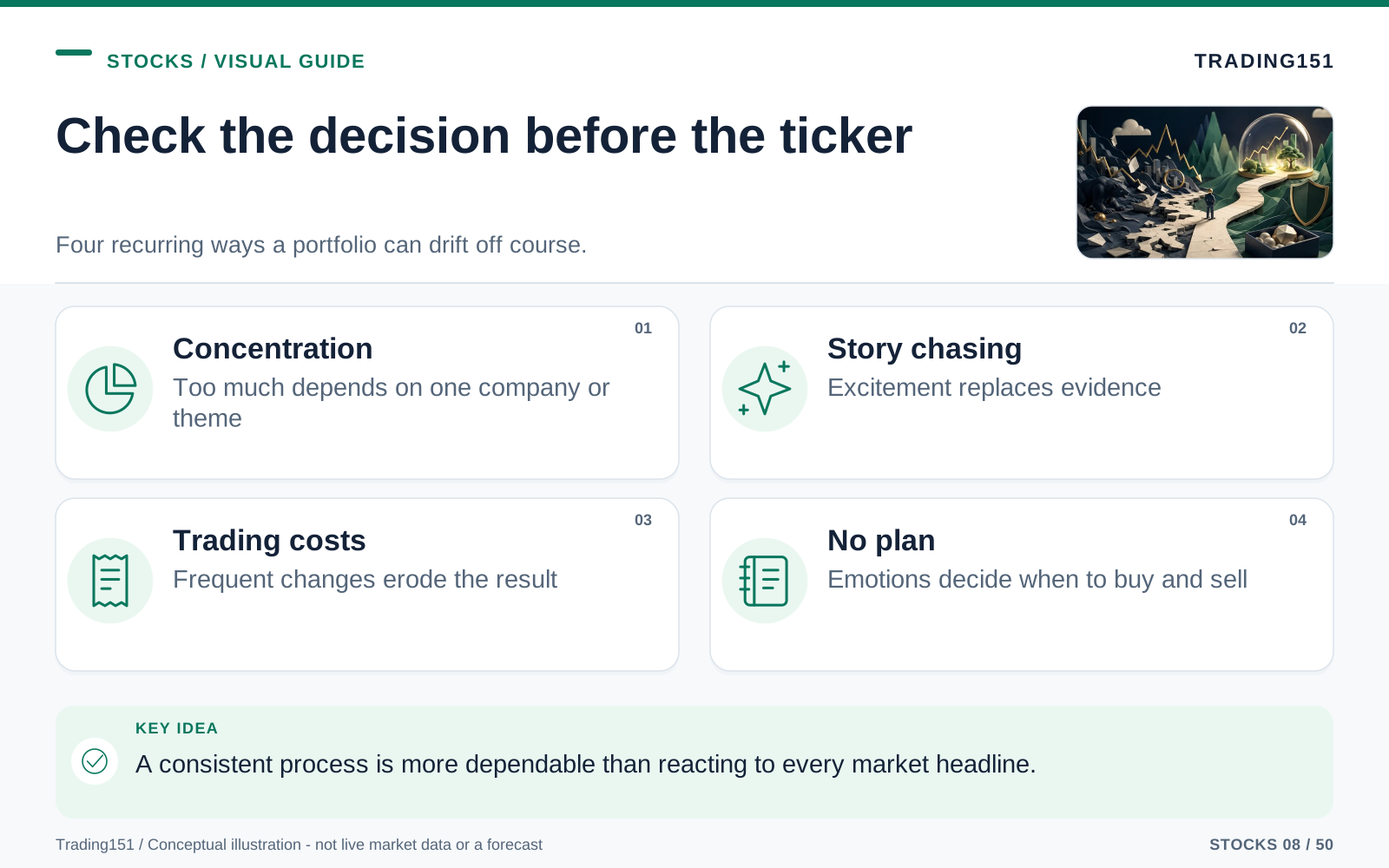
Read this diagram as text
- Concentration
- Too much depends on one company or theme
- Story chasing
- Excitement replaces evidence
- Trading costs
- Frequent changes erode the result
- No plan
- Emotions decide when to buy and sell
2. Panic Selling During a Market Drop
If FOMO drags you in at the worst possible time, panic kicks you out at an equally bad moment. Watching your hard-earned money shrink on a screen is deeply unsettling. The numbers get smaller, the headlines get apocalyptic, and the urge to just sell everything and stop the bleeding becomes overwhelming.
In the heat of the moment, cashing out feels like the responsible thing to do. You tell yourself you’ll just buy back in when the dust settles and things look safe. But here's the catch: the market never sends an "all clear" signal. By the time things feel safe again, prices have usually already rebounded.
It’s a cruel irony of the stock market. The moments that feel the most dangerous are precisely when patient investors are being tested, not necessarily when they should be running for the exits.
How to avoid it: Decide how you'll handle a crash before it happens. A 10% or 20% drop isn't a glitch; it's a completely normal feature of investing. If your strategy only works when prices are going up, it’s not a real plan. Write down your reasons for buying a stock and the specific conditions that would make you sell. Having a physical plan to look at can talk you off the ledge when your nerves start screaming at you.
3. Investing Without a Clear Goal
A lot of people start out saying, "I just want to make more money." Which, sure, makes sense—but it’s not a strategy. What is the money for? A house down payment in three years? Retirement in thirty years? Your kid’s college fund? A quick trade?
The timeline dictates the strategy. Money you need next year shouldn't be treated anything like money you won't touch for decades. Going heavy on stocks makes total sense for long-term growth, but it's a huge gamble if you need to cash out to pay a tuition bill soon.
Without a specific goal, the market’s daily noise will drive you crazy. A minor dip feels like a crisis. A random stock tip feels like a must-take opportunity. You end up reacting to everyone else's opinions because you don't have a personal benchmark to guide your choices.
How to avoid it: Give every dollar a job description. If its job is long-term wealth building, you can afford to think in decades and ignore the dips. If its job is protecting funds for a near-term expense, it probably shouldn't be in the stock market at all. Knowing why you're investing makes it easy to ignore advice that just doesn't fit your life.
4. Treating the Market Like a Casino
Investing and gambling might look similar from a distance—both involve risk, both have winners and losers, and both can be a rush. But the difference lies entirely in the mindset and the process.
Gamblers are chasing a quick hit; they want to know what’s going to pop this week. Investors are trying to buy pieces of real businesses that will grow in value over time. A gambler asks, "What's going to the moon?" An investor asks, "What am I comfortable holding through good years and bad?"
The casino mentality creeps in subtly. Maybe you buy a stock because you recognize the ticker, or you throw money at a company after reading a single Reddit thread. Or maybe you just keep trading because doing nothing feels boring. You might get lucky a few times, but luck is not a sustainable strategy.
How to avoid it: Create a little friction for yourself. Institute a 24-hour waiting period before you buy any individual stock. Write down exactly why you're buying it and cap how much of your portfolio you're willing to risk on it. If your desire to buy can't survive a single night's sleep, it was just an impulse.
5. Putting Too Much Money Into One Stock
We’ve all heard the legend of the guy who bought a tech giant early and retired on a yacht. It’s a great story. But no one talks about the thousands of people who went all-in on a single company only to watch their life savings go up in smoke. Sometimes, a single stock becomes a large chunk of your portfolio purely by accident—it just keeps growing. That feels amazing right up until the company hits a wall.
An "unbeatable" stock is only unbeatable until it isn't. Management makes a terrible call, competitors innovate, regulations shift, or the product simply stops being relevant. Even world-class companies can go through decade-long slumps.
Putting all your eggs in one basket can build wealth fast, but it can destroy it even faster. This is substantially dangerous if you also work for the company. If the business goes under, you could lose your paycheck and your nest egg on the same day.
How to avoid it: Diversify before you're forced to. Index funds and ETFs are fantastic because they let you own a tiny slice of hundreds of companies at once. You don’t need to find a needle in a haystack if you just buy the whole haystack. Your financial security shouldn't rely on one CEO making perfect decisions forever.
6. Confusing a Good Company With a Good Investment
This one trips up a lot of smart people. Just because a company makes products you love and has stellar earnings doesn't automatically mean its stock is a smart buy.
People constantly overpay for greatness. They love their phone or their favorite coffee chain, so they assume the stock is a guaranteed winner. But Wall Street already knows it's a great company, and the price usually reflects that. If you buy at a price that demands impossible future growth, even a wonderful business will leave you with a lousy return.
On the flip side, a terrible stock chart doesn't mean a company is a secret bargain. Sometimes the market overreacts, sure, but other times, the business really is just dying.
How to avoid it: Remember that you are buying the stock, not just the brand. You have to ask, "Is this a good business?" alongside "What expectations are already baked into this price?" You don’t need to be a Wall Street analyst, but you do need to recognize that a great story isn't worth an infinite price tag.
7. Trying to Time the Perfect Entry
It feels responsible to wait for the "perfect" moment to invest. You tell yourself you’ll jump in after the election, or after the next Fed meeting, or once the market corrects. There is always a compelling reason to sit on the sidelines.
But the perfect time to invest only exists in the rearview mirror. When stocks are cheap, the news is usually concerning. When the coast looks clear, stocks are already expensive. People who sit on piles of cash waiting for a clean entry signal routinely miss out on years of compounding growth.
Timing the market is virtually impossible, not because you aren't smart enough, but because the future is a mess. Prices shift every second based on global surprises, human emotion, and daily news. Guessing when to get out is hard; guessing when to get back in is nearly impossible.
How to avoid it: Make it automatic. Pick a set amount to invest every month or every paycheck, and stick to it regardless of what the headlines say. This is called dollar-cost averaging. It’s admittedly boring, but it works. You naturally buy more shares when they're cheap and fewer when they're pricey, completely removing the stressful guesswork of market timing.
8. Following Gurus Instead of Doing Your Own Thinking
These days, everyone with a smartphone is a financial guru. Some are helpful; others are just entertainers putting on a show. Just because someone wears a nice suit, speaks with total confidence, or has a million followers doesn’t mean they know what they’re talking about.
The biggest red flag is absolute certainty. If someone tells you a stock is guaranteed to explode or that you’re a fool if you don't buy right now, run. Markets aren't that predictable. Anyone promising risk-free riches is usually selling you something, not analyzing reality.
And even if they happen to be right, their strategy might be entirely wrong for you. They might be day trading while you're saving for retirement. You never get to see their full financial picture, their hidden losses, or the exact moment they decide to sell.
How to avoid it: Use outside opinions as a starting point, never as gospel. If someone pitches an interesting stock, do your own homework before opening your wallet. And hey, if you don't want to research companies yourself, that’s perfectly fine! Just buy a broad index fund. You never have to hand over your financial decisions to the loudest guy on the internet.
9. Checking Your Portfolio Constantly
Today’s investing apps are basically beautifully designed slot machines in your pocket. You can check your net worth while waiting for your coffee, sitting in traffic, or lying in bed. It feels like you're staying informed, but really, you're just soaking in noise.
The more you look at your portfolio, the more you'll find reasons to stress. A totally normal daily dip feels like a disaster. A sudden spike makes you feel like an invincible genius. A flat week makes you anxious. Staring at the screen tricks your brain into thinking you need to do something.
Long-term investing rewards patience, but apps reward engagement. Those two things are entirely at odds. If you aren't careful, the constant notifications will train you to be a frantic day trader, even if you set out to be a buy-and-hold investor.
How to avoid it: Put yourself on a diet. Checking your accounts once a month—or even once a quarter—is plenty for a patient investor. Use that time to make sure your overall strategy is on track, not to hyperventilate over a 2% dip. If you can't resist the urge to refresh the screen, delete the app from your phone entirely and force yourself to log in on a laptop.
10. Trading Too Often
Clicking "buy" and "sell" feels like progress. You're taking action! You're managing your money! But in investing, activity and progress are rarely the same thing.
Every time you make a trade, you're opening the door to being wrong. Plus, frequent trading racks up hidden costs—taxes, bid-ask spreads, and sheer emotional fatigue. Even if trading is totally free on your app, you end up paying for it by making rushed, reactive decisions.
Often, we trade just because we're uncomfortable being bored. A solid portfolio is pretty dull most of the time. It just sits there for months on end. In a world where we expect instant gratification and constant updates, that lack of action can feel deeply unnatural.
How to avoid it: Embrace the boredom. Before you place a trade, ask yourself what problem you're trying to solve. If the honest answer is "I'm bored" or "I'm feeling anxious," close the laptop. The absolute best investing usually looks like a whole lot of nothing.
11. Ignoring Fees
Fees are sneaky because they look so microscopic. What’s 1% here or half a percent there? In a single year, you won't even notice it. But over decades, those tiny percentages compound into a large chunk of your potential wealth.
Investing is all about the magic of compounding—you want your money making money. High fees act like a constant leak in your bucket, draining your returns year after year, whether the fund performs well or entirely tanks.
Some actively managed funds might justify their fees, but most don't. Paying a premium doesn't guarantee you a premium return. Usually, a dirt-cheap index fund will quietly outperform the pricey, heavily marketed alternative anyway.
How to avoid it: Always check the expense ratio before buying a fund or ETF. The closer it is to zero, the better. Keep an eye out for account fees, advisory costs, and hidden commissions. You can't control what the stock market does, but you have total control over how much you pay to play the game.
12. Forgetting About Taxes
No one likes thinking about taxes. But ignoring them can result in a painfully expensive reality check come April. Selling a stock for a quick profit might feel great until you realize Uncle Sam wants a hefty cut. Even regular dividends can trigger unexpected tax bills. The only number that matters is what stays in your pocket after taxes.
A lot of active traders end up slicing their own returns to pieces just because they didn't factor in capital gains taxes. Others unknowingly stash their least tax-efficient investments in the wrong types of accounts. You shouldn't let the fear of taxes dictate every move you make, but they absolutely need to be part of the equation.
How to avoid it: Get familiar with the basic tax rules for your country, or hire a professional if you're dealing with big numbers. Take full advantage of tax-advantaged retirement accounts whenever you can. Before you sell a winner in a moment of panic or excitement, pause and calculate the tax hit. A profit is great, but keeping it is even better.
13. Averaging Down Without Rechecking the Story
Buying more of a stock after it drops isn't inherently a bad idea. If the business is fundamentally strong and the market is just throwing a tantrum, it can be a phenomenal opportunity. The problem starts when you buy more simply because you refuse to accept you made a mistake.
This is how investors end up throwing good money after bad. You watch a stock sink, so you buy more to lower your average cost. Then it drops again, and you buy more. Before long, you aren't investing in the company's future; you're just desperately trying to salvage your ego.
The hard truth is that the market doesn't care what you paid for a stock, and it has absolutely no obligation to bounce back. A stock that has crashed 50% can easily fall another 50%. It has to come back eventually is a hope, not an investment thesis.
How to avoid it: If a stock you own is falling, pretend you don't own it at all. Look at the company as it stands today. Would you buy it right now with fresh cash? Has the actual business improved, or is it falling apart? If your only motivation to buy more is to make your spreadsheet look a little less depressing, don't do it.
14. Taking on Risks You Do Not Understand
The financial world is packed with highly complex tools: options, margin loans, leveraged ETFs, and short selling. They sound sophisticated, and in the hands of seasoned pros, they can be useful. But for the average investor, they're like playing with fire.
The danger isn't just that these tools are risky; it's that they behave in weird, unpredictable ways that beginners just don't see coming. You can get the general direction of a stock right and still lose all your money with options. And trading on margin (using borrowed money) can turn a run-of-the-mill market dip into a total financial wipeout.
There is absolutely no shame in sticking to the basics. In fact, knowing what to avoid is a superpower. The market hands out thousands of opportunities every day; you don't have to swing at the complicated ones.
How to avoid it: Keep it simple. If you can't explain exactly how an investment makes money, how much it could realistically lose, and what the absolute worst-case scenario looks like, don't touch it. Complexity belongs in your portfolio only if you fully grasp it, not just because it makes you feel like a Wall Street insider.
15. Investing Money You Will Need Soon
The stock market is an amazing wealth-building engine for the long haul, but it is a terrible place to park your rent money. This is a vital lesson to learn early on. If you need cash in the next year or two, you simply can't afford the risk of the market taking a sudden nosedive right before your bill is due.
Life doesn't care about market cycles. Roofs leak, cars break down, and jobs disappear. If your emergency fund is tied up in stocks and the market tanks right when disaster strikes, you'll be forced to sell at the absolute worst possible time.
Being forced to cash out during a crash turns a temporary paper loss into a permanent, painful reality. Plus, the sheer stress of gambling with your safety net just isn't worth it.
How to avoid it: Separate your timelines. Keep your emergency fund and any short-term cash (like a house down payment) in a boring, stable savings account. It won't make you rich, but that's not its job. Its job is to be there when things go sideways, giving your real investments the uninterrupted time they need to grow.
16. Never Rebalancing Your Portfolio
Even the most perfectly planned portfolio has a way of wandering off track over time. Let's say you set up a nice, balanced mix of stocks and bonds. Then, tech stocks go on a large multi-year tear. Without doing a thing, your portfolio has quietly morphed into a highly aggressive, tech-heavy gamble.
That silent drift completely changes your risk profile. A setup that felt safe a few years ago can suddenly become concerning during a market correction, simply because one asset class grew out of control.
Rebalancing isn't about predicting the future or timing the market. It's just basic maintenance to keep your risk level exactly where you originally wanted it. It naturally forces you to sell high (trimming what has grown too large) and buy low (adding to what has shrunk).
How to avoid it: Pick a date once or twice a year to pop the hood and check your allocations. If things have drifted too far from your original plan, sell a little of what's gone up and buy a little of what's gone down. It’s a simple habit that keeps your risk in check without requiring a crystal ball.
17. Expecting the Stock Market to Feel Comfortable
A lot of people think that once they learn enough about investing, they'll finally feel totally calm and collected. Honestly? That day never comes. There will always be some concerning headline, an economic crisis, or an expert predicting the end of the world.
The goal isn't to stop feeling anxious. The goal is to stop letting that anxiety dictate what you do with your money. The best investors aren't emotionless robots who never feel fear or greed. They're just ordinary people who feel those exact same emotions but choose to stick to their plan anyway.
This is why knowing yourself is half the battle. The best portfolio isn't the one that mathematically maximizes returns on a spreadsheet. It’s the one you won't panic-sell when the world feels like it's ending.
How to avoid it: Build a strategy that matches your personality, not the fearless version of yourself you wish you were. If volatility keeps you up at night, it's okay to hold more bonds. If you know you're prone to chasing trends, automate your contributions so you don't even have to log in. Find a plan you can comfortably live with.
Treat a new purchase as a fresh decision
Imagine buying a stock at $80 and watching it fall to $50. Your original purchase price is part of the record, but it is not evidence that the stock must return to $80. Before adding money, ask whether you would buy it today without the existing holding. If the answer is no, averaging down needs a stronger explanation than wanting a lower break-even price.
Write the new decision as though it were independent. What has changed in the business? What has changed in valuation? How much of the portfolio would the combined position represent? A lower price can improve prospective returns when the underlying outlook is intact, or reflect damage that the original thesis missed. The chart alone cannot tell you which.
The opposite problem appears after a large gain. A position may grow beyond the risk level you originally accepted. Keeping every share simply because selling feels disloyal to a winner is still a decision about today's exposure. Compare it with your plan, costs, and tax position rather than with the emotional satisfaction of having been right.
A brief written review can interrupt both habits. It need not predict the next price move. It only needs to make the present choice explicit. Your past decision deserves an honest assessment, not a lifelong commitment to defend it with new money.
Distinguish a lower price from a better investment
A share that falls from $80 to $40 is cheaper per share, but not necessarily better value. Earnings prospects, debt, or the number of shares may have changed. Rebuild the case using today's information rather than anchoring on the earlier quotation. Averaging down should be a new allocation decision with a current rationale, not an attempt to make the original purchase look less uncomfortable. 1
Make Mistakes Small Enough to Learn From
Here's the truth: you don't have to be perfect to succeed in the stock market. You are going to make mistakes. Everyone does. You'll buy at the top, sell at the bottom, hold onto a dud for too long, or get sucked into a ridiculous fad. Welcome to the club—it just means you're human.
Even the most disciplined investors misjudge companies or panic on occasion. The trick isn't having a flawless track record. It's making sure your mistakes are small enough that you can survive them, learn from them, and never repeat them in the same way.
Whenever things go wrong (or right!), take a step back and judge your actual decision, not just the final outcome. Sometimes you get lucky with a dumb move; sometimes you make a brilliant bet that just doesn't pan out. By writing down why you made a choice, you protect yourself from confusing dumb luck with genuine skill.
A highly successful investing strategy usually looks boring from the outside. It’s built on clear goals, broad diversification, low fees, and giving your money years to compound. Boredom isn't a lack of ambition—it's just what's left over when you strip away the emotional mistakes that constantly transfer wealth from the impatient to the patient.
Sources and further reading
Editorial revision: 7 October 2026. Numerical scenarios are hypothetical unless identified as historical. References support the added explanations and selected corrections; rules and product terms should be checked again before acting.