
A sensible person can make poor investment decisions without lacking intelligence or information. Money brings pride, anxiety, regret, and comparison into the same room. Behavioral finance helps explain how those pressures affect judgment. Its practical value is not in diagnosing every feeling, but in building habits that leave less room for a bad moment to become an expensive decision.
The Pain of Losing: Why Losses Feel Bigger Than Gains
Imagine I offered you a bet on a coin flip: Heads, you win $100. Tails, you lose $100. Mathematically, it’s a perfectly fair trade. But emotionally? It probably feels like a bad deal. If you're like most people, you'd pass on the gamble. It's not because you don't understand the math, but because the sting of losing a hundred bucks is a lot sharper than the joy of winning it.
That gut reaction is called loss aversion, and it dictates so much of what we do with our money. In the market, it creates a toxic dynamic where we sell our winning investments way too early just to feel the high of locking in a profit, while stubbornly holding onto our losers so we don’t have to face the pain of being wrong. To fight this, try asking yourself: If I had cash instead of this stock today, would I still buy it at its current price? It’s a tough question, but it helps break the emotional spell of whatever price you originally paid.
Loss aversion is sneaky. Say a stock you own plummets 25%. Instead of objectively asking if the business is still sound, you might find yourself bargaining with the ticker symbol. “I’ll just wait until it gets back to what I paid, then I’ll sell.” “It’s just a paper loss.” These little lies comfort us, but they trap our money in dead-end trades. The severe truth is that the market doesn’t care what you paid for a stock. Your break-even price only matters to your ego; it has absolutely zero bearing on the company's actual future.
It works in reverse, too. Have you ever watched a stock go up 20% and suddenly felt anxious? Instead of letting a thriving business continue to grow, the urge to "lock in the gain" takes over. We take a tiny profit because it feels safe, and we label holding a proven winner as "risky" because that paper profit could vanish. The classic result? We end up cutting our flowers to water our weeds.
The trickiest part is that loss aversion loves to wear a disguise. Holding onto a falling stock feels like patience. Cashing out a rising star feels like prudence. Sure, sometimes those are the right moves. But if you’re acting mainly because you can’t stomach the emotional discomfort of uncertainty, that’s not discipline. That’s just fear dressed up in a sensible suit.
How to handle it: Figure out your exit strategy before you even hit the buy button. Jot down exactly why you’re investing, what would prove your theory wrong, and how much turbulence you’re willing to sit through. If the business is still firing on all cylinders and the whole market is just having a bad month, you probably don't need to do anything. But if the facts have fundamentally changed, taking a loss isn't a failure—it’s just respecting reality.
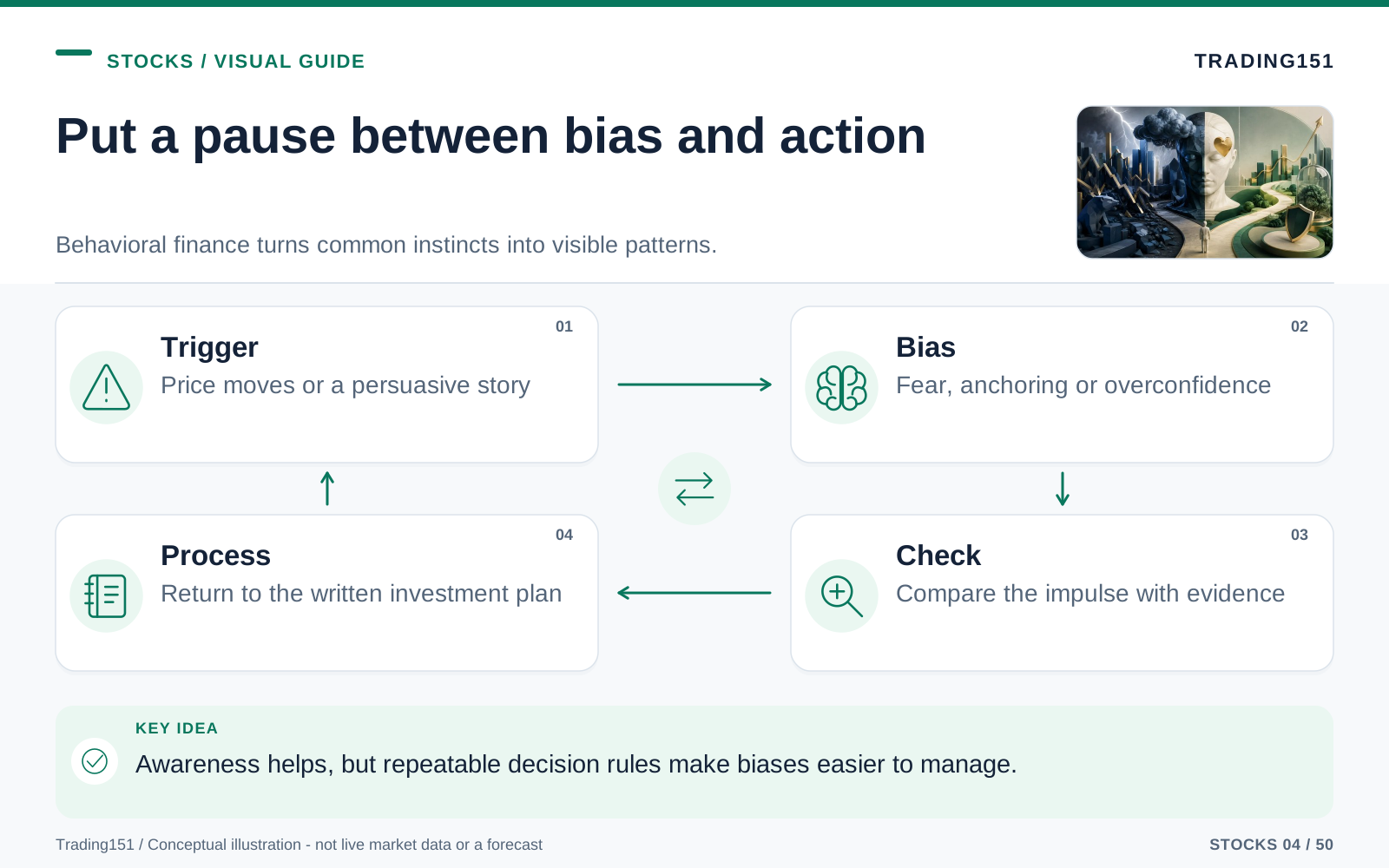
Read this diagram as text
- Trigger
- Price moves or a persuasive story
- Bias
- Fear, anchoring or overconfidence
- Check
- Compare the impulse with evidence
- Process
- Return to the written investment plan
The Pull of the Crowd: Herd Mentality and Market FOMO
We are substantially social creatures. For thousands of years, doing exactly what the rest of the group did wasn’t a personality flaw—it was how you survived. If everyone in your tribe suddenly started sprinting in one direction, you didn’t stop to weigh the pros and cons. You just ran.
That primal instinct is still very much alive, but today it plays out on trading apps and social media feeds. Instead of running from a predator, we’re watching strangers online post screenshots of life-changing profits. We hear breathless predictions that a certain crypto coin or tech stock is "the undeniable future." Suddenly, the fear of losing money evaporates, replaced by something much stronger: the agonizing fear that everyone else is getting rich without you.
We call this herd mentality, though most of us just know it as FOMO (Fear Of Missing Out). It’s that heavy, anxious pressure you feel to jump into a trade just because there's a loud crowd cheering it on. The stock might be absurdly overpriced. The business model might be a joke. The risks might be glaring. But when the crowd is roaring, playing it safe suddenly feels like you're just being a coward.
Financial history is practically just a timeline of the crowd convincing itself that "this time is different." The dot-com boom was based on real internet innovation, sure, but it also tricked people into believing that any company with a ".com" in its name was worth billions. The 2008 housing crisis fed on the delusion that real estate simply couldn't go down. More recently, meme stocks and crypto crazes have shown how fast online communities can turn wild speculation into a deeply held identity. Some people made fortunes in those moments, absolutely. But a whole lot more showed up late to the party, buying the top just as the smart money was cashing out.
The really dangerous thing about bubbles is that they never feel crazy when you’re inside them. They feel electric, urgent, and totally logical. There’s always a compelling story. There’s always a buddy who made a quick grand. And there’s usually a grain of truth in the hype—which is exactly what makes it so dangerously seductive.
How to handle it: Just pause. If a trade only looks good because your feed won't shut up about it, take a large step back. Ask yourself: Would I still buy this today if the price flatlined for three years and nobody ever tweeted about it again? If your answer is no, you aren't investing in a company. You’re just buying a ticket to the hype train.
Seeing What We Want to See: Confirmation Bias
The moment we buy something, we lose our objectivity. A stock on your watchlist is just a ticker. But once it's in your portfolio? It’s personal. It becomes part of your story. When it goes up, you're a genius. When it drops, it feels like a direct insult. This emotional baggage perfectly sets the stage for our worst habit: eagerly embracing anything that proves us right, while completely ignoring anything that proves us wrong.
If you’re bullish on a company, you probably fall victim to confirmation bias all the time. You read every glowing analyst report, bookmark the upbeat charts, and follow the optimistic fans. Meanwhile, you casually dismiss any negative news as "short-seller manipulation," biased journalism, or just irrelevant noise. You stop seeking out the truth and start seeking out a cheering section.
The real danger here isn’t that the optimists are always wrong or the critics are always right. The danger is that you stop keeping score honestly. Without realizing it, your goal shifts from understanding the business to just defending your ego. You stop doing research and start going on a scavenger hunt for reassurance.
You see this all the time with "story stocks"—companies built on charismatic founders, revolutionary tech, or intensely loyal fanbases. When the narrative is that intoxicating, it’s remarkably easy to forgive terrible balance sheets, missed deadlines, or looming competitors. A great story can keep investors holding on for dear life long after the actual evidence screams "sell."
But it happens in boring ways, too. A permabear who thinks the economy is doomed will only click on articles about impending. A losing trade? Ah, the market is just acting irrationally today. That mindset completely destroys your ability to learn from your mistakes.
One of the most obvious red flags is constant trading. The more someone believes they can predict tomorrow's stock prices, the more they jump in and out of the market. But every trade comes with friction: taxes, hidden fees, bid-ask spreads, and the sheer mental exhaustion of staring at charts all day. Even when those costs seem tiny, they quietly eat away at your returns over time.
It also tempts you to put all your eggs in one basket. Someone substantially confident in their own foresight might dump half their life savings into one obscure tech company. Yes, crazy concentration can make you rich if you happen to be right. But it can also wipe you out when you inevitably confuse a strong hunch with absolute certainty.
How to handle it: Keep yourself honest. Track your trades, but more importantly, track why you made them. Did you make money because your reasoning was spot-on, or did you just get bailed out by a broad market rally? Set strict limits on how much of your portfolio can go into a single idea, and stay humble. The market is the ultimate humbling machine, and it always eventually comes for the people who think they're smarter than it.
Stuck on a Number: The Anchoring Effect
Have you ever walked into a store and seen a jacket marked down from $300 to $150? Suddenly, it feels like an absolute steal. Your brain latched onto that $300 tag, making the new price look amazing by comparison. But if you’d walked in and the jacket was just priced at $150 from the start, you might have scoffed and walked right out. That initial $300 is an anchor, and it completely hijacks your perception of value.
In the stock market, anchoring happens when we become emotionally glued to a specific number, even if it has absolutely nothing to do with what a company is worth right now. Usually, it’s the price you paid for the stock. If you bought in at $80, then $80 magically becomes the center of your universe. If it’s trading below that, you feel cheated. Above it, you feel validated. But here's the harsh reality: the company’s fundamentals do not care what you paid for its shares.
The "52-week high" is another notorious trap. A stock that used to trade at $200 and now sits at $50 looks undeniably cheap on a chart. And sure, sometimes the market overreacts and hands you a genuine bargain. But a stock down 75% isn't automatically a steal. If the core business is collapsing, it's still substantially overpriced at $50. A stock that fell from $200 to $50 can easily fall from $50 to zero for perfectly valid reasons.
We even anchor our expectations. If you started investing during an incredible bull run and saw 20% returns for a few years, your brain accepts that as the new normal. So when a perfectly healthy, average year hands you 8%, you feel totally let down. We do it with housing prices, interest rates, and dividend yields. Once our brains get used to a number, letting it go is an uphill battle.
Remembering past prices isn't the problem. The problem is treating those old numbers like they're a sacred promise. The market is just a live feed of millions of people constantly repricing new information. A past all-time high is just a piece of trivia; it’s not a guarantee.
How to handle it: Try looking at your portfolio with a case of deliberate amnesia. If you didn’t already own this stock, would you buy it today at its current price? If you wiped that glorious 52-week high off the chart, would it still look like a smart buy based on actual cash flow and balance sheets? If you’re just holding out hope for it to hit a ghost number from the past, it’s time to move on.
Different Buckets, Same Money: Mental Accounting
Mathematically speaking, a dollar is a dollar. Whether it comes from your paycheck, a lucky lottery scratcher, a tax refund, or a stock dividend, it buys the same amount of groceries. But psychologically, we almost never treat it that way.
Mental accounting is our quirky habit of putting our money into imaginary emotional buckets. Rent money is treated with intense respect. An unexpected bonus is "fun money." Dividends feel like free income, while selling a few shares feels like a stressful failure. We slap labels on our cash that completely change how we spend it, even though the math doesn't change at all.
This quirk leads to some truly bizarre financial choices. You might be fiercely protective of the cash in your savings account, but blindly throw a $5,000 tax refund at a highly speculative meme coin because it feels like "house money." Or you might happily spend your dividends while refusing to sell a toxic asset in another account because you "don't want to lock in the loss." If you zoomed out and looked at all your wealth as one single pot, those decisions would look completely irrational.
To be fair, mental accounting isn't entirely bad. Budgeting relies on it, and it’s a great tool to keep your spending in check. The problem starts when these imaginary buckets overrule basic common sense. Money labeled "house money" is still your money, and losing it still hurts your net worth. Cash hoarded in a "super safe" checking account is still losing its purchasing power to inflation.
How to handle it: Force yourself to look at the big picture. Your net worth is one giant, interconnected system. Before you gamble away a sudden windfall, ask yourself: If I had just earned this exact amount of money by working 60 hours this week, would I still blow it on this speculative trade? It’s amazing how quickly that question sobers you up.
The Stories We Tell After the Fact: Hindsight Bias
The day after a large market crash, everyone suddenly claims they saw it coming. When a tiny tech startup becomes a trillion-dollar giant, people talk about it like it was an inevitability. This is hindsight bias in action, and it’s our brain’s way of making the messy, chaotic past look beautifully predictable.
Hindsight bias is substantially comforting. It takes a terrifyingly random world and gives it a neat, digestible storyline. Once we know how things pan out, we subconsciously rewrite our own memories. We convince ourselves that we knew it all along, conveniently forgetting how deeply uncertain we felt at the time. It gives us a false sense of control over the future.
The fallout from this is dangerous. If you truly believe that past market crashes were easily predictable, you’re going to be overly confident about timing the next one. You might beat yourself up for missing out on the "obvious" rise of Amazon or Bitcoin, judging your past self with information you couldn't possibly have had at the time.
The philosopher Søren Kierkegaard nailed it when he said life can only be understood backward, but it must be lived forward. Markets are exactly the same. In the heat of the moment, the future is murky. You’re drowning in conflicting data, screaming pundits, and plausible arguments on both sides. A great investor doesn't pretend they have a crystal ball; they just build a portfolio that can survive the fog.
How to handle it: Start keeping receipts on your own brain. Write down a quick note when you buy a stock: what you expect to happen, what you're worried about, and what would make you sell. Months later, compare what happened to your original notes. It strips away the rose-colored glasses of hindsight and forces you to confront exactly how you were thinking in the moment.
When Recent Events Feel More Important Than They Are
Financial media thrives on making whatever happened five minutes ago feel like the most important event in human history. A surprisingly bad inflation report, a hawkish quote from a central banker, a single disastrous earnings call—suddenly, it’s all anyone can talk about. This triggers recency bias, which is our brain's terrible habit of assuming that whatever is happening right now is going to keep happening forever.
If the market goes up for three years straight, we start believing a 15% annual return is a birthright, and all sense of risk goes out the window. Conversely, if we’re stuck in a severe, grinding bear market, we become convinced that every little rally is a trap and the global economy is permanently doomed. We let the recent past completely blind us to long-term reality.
This right here is exactly why so many everyday investors consistently buy at the absolute top and sell at the miserable bottom. When stocks have been surging for months, throwing money at the market feels safe because optimism has been continuously rewarded. When stocks have been plunging, cashing out feels brilliantly protective. We let the emotional exhaustion of the last few weeks overpower decades of historical market data.
It even dictates how we view entire asset classes. A booming decade for US tech stocks makes everyone forget that international stocks ever existed. A sudden spike in savings account interest rates makes people abandon the stock market entirely, forgetting that inflation will eventually eat those cash yields alive. We take a temporary chapter of market history and mistakenly adopt it as a permanent rule.
How to handle it: Just zoom out. Stretch your time horizon way past what feels natural. One concerning month doesn't invalidate a smart, long-term strategy. One phenomenal year doesn't make you the next Warren Buffett. Markets move in large, sprawling cycles, and no condition lasts forever. If you build your financial life around the humble acceptance that everything changes, you’ll be much better off than reacting to the latest breaking news.
Building a System That Protects You From Yourself
The endgame of understanding behavioral finance isn’t to transform into a cold, unfeeling robot. That’s impossible, and it misses the point of being alive anyway. The goal is simply to stop pretending that your emotions somehow evaporate the second you log into your brokerage account. If anything, throwing money into the mix turns the volume on your emotions all the way up.
A solid investing system just accepts this reality. It doesn’t demand that you maintain a zen-like calm during a global panic. Instead, it builds the guardrails before the panic ever arrives. It’s about making good decisions practically automatic and impulsive decisions difficult to execute. You shouldn’t have to wrestle your emotions into submission every day. A good system simply avoids the wrestling match altogether.
Put it on autopilot. Automating your investments is like a superpower because it completely removes the burden of choice. You don’t have to wake up and debate if today "feels" like a good day to buy. Past-you—the calm, rational version of you—already made the choice. Dollar-cost averaging isn’t flawless, but it entirely kills the urge to sit on cash forever waiting for the "perfect" dip.
Set your rules during peacetime. Decide exactly what percentage of your money goes into individual stocks, when you'll rebalance, and precisely what metrics would force you to sell a stock. Do this on a boring, quiet Tuesday. Rules forged in the fires of a market crash are usually terrible. Rules written during a crypto euphoric high are even worse. Write your playbook when you're bored, not when you're sweating.
Stop staring at your screen. If you’re investing for retirement in twenty years, what the S&P 500 did at 1:15 PM today is utterly irrelevant. Checking your portfolio every day just trains your brain to treat daily noise as vital information. It gives your anxiety a microphone. For most of us, looking at our accounts once a quarter is plenty.
Diversify to sleep better, not just for the math. Advisors usually pitch diversification with dense charts about risk-adjusted returns. But honestly? Its biggest benefit is purely psychological. Spreading your money across different sectors, company sizes, and countries makes your portfolio far less dramatic. It gives you permission to stop stressing over one bad earnings report. The "best" portfolio isn't the one that looks perfectly optimized on a spreadsheet—it's the one you won't panic-sell during a recession.
Give yourself a sandbox. If you love diving into earnings calls and hunting for the next big tech disruptor, don't suppress that entirely. Just put a fence around it. Carve out a small "explore" bucket—maybe 5% of your money—while leaving the serious bulk of your wealth in boring, diversified funds. That way, you get to scratch the itch and play the game without risking your actual retirement.
Put speed bumps in your own way. If you know you’re a sucker for an impulsive trade, make it physically harder to execute. Delete the trading app from your phone's home screen. Enforce a mandatory 24-hour waiting period before buying a stock you just heard about on a podcast. These tiny moments of friction give your logical brain just enough time to catch up with your racing heart.
What Behavioral Finance Does Not Mean
Let's be crystal clear about something: acknowledging your psychology doesn't give you a free pass to ignore the math. It doesn't mean cash flows, debt levels, and profit margins suddenly don't matter. You can't just chalk every stock movement up to "human emotion." Valuations matter. Fundamentals matter. Price still dictates your ultimate return.
Behavioral finance just points out that the person reading that balance sheet is a flawed human being. Two highly educated investors can look at the same quarterly report and walk away with two completely opposite conclusions because they have different fears, incentives, and blind spots. The raw data is crucial, but the mind processing that data is just as important.
And no, this doesn't mean your gut instincts are always completely wrong. Sometimes, fear is trying to save you from a disaster. Sometimes, the crowd is pointing at a real, undeniable trend. A plunging stock really can be a once-in-a-decade bargain. The objective isn't to distrust every emotion you feel. The goal is simply to demand hard evidence before letting those emotions drive your car.
The greatest investors in the world aren't unfeeling sociopaths. They're just self-aware. They know exactly how they are wired to fail, and they build brilliant systems to protect themselves from their own worst habits.
Review the decision before you look at the result
Take two investments. The first follows a well-researched plan but loses money after an unexpected event. The second is an impulsive purchase that happens to rise. Judging only by the outcome teaches the wrong lesson: abandon the careful process and repeat the gamble. Neither conclusion is supported by one result.
A decision journal can make the difference visible. Before buying, record what you believe, which evidence supports it, what would change your mind, and how much uncertainty remains. Add the alternatives you rejected. At the review date, read that entry before checking the latest price. This makes it harder to replace the original reasoning with a cleaner story invented afterward.
Keep the review concrete. Did you overlook debt that was disclosed? Confuse a temporary margin benefit with a lasting improvement? Buy more because the evidence improved, or because the loss felt embarrassing? These questions are more useful than simply writing that you were emotional. They identify a change that can be made to the process.
The aim is not to eliminate all emotion. That would be an unrealistic standard and an unhelpful excuse to keep redesigning the system. A workable safeguard is small enough to use when you are tired: a written reason, a delay before increasing exposure, or a second look at the downside. Repeated regularly, those habits create a record you can learn from rather than a collection of memories that flatter you.
A good decision can still lose money
Imagine two investors considering the same risky company. One reads the filings, limits the position, and records the conditions under which the investment would no longer make sense. The other buys because a stranger promises a quick gain. The shares then double. That result does not erase the difference between the two processes. Equally, a loss would not establish that the careful investor was irrational.
This is why a review needs two separate questions. Was the decision reasonable using the information available at the time? What did the outcome teach us about the assumptions? Combining them encourages outcome bias: a profitable gamble gets promoted into a sound method, while a sensible decision with an unlucky result gets abandoned.
The separation should not become an excuse to defend a failing strategy forever. Repeated disappointments may reveal a weakness that was initially hard to see. The useful habit is to state what evidence would change the assessment before the emotional pressure arrives. A review date, a business milestone, or a clearly defined risk limit can make that commitment concrete. The goal is neither perfect detachment nor endless self-criticism. It is to learn without rewriting the original decision to suit the ending. 1
The Edge Is the Pause Before You Act
If you watch financial TV, investing looks like a severe war of intellect. Who has the fastest algorithm? Who uncovered the secret metric? Who called the top? That stuff might matter for hedge fund managers. But for the rest of us, the ultimate investing edge is boring, unglamorous, and vastly more powerful: our temperament.
Can you quietly keep buying index funds when the news is concerning? Can you watch your neighbor buy a sports car with crypto winnings and not feel the need to blindly copy him? Can you swallow your pride and admit when an investment thesis is broken? Can you sit on your hands and just let a great company compound for a decade?
You can’t quantify those questions in a financial model, but nine times out of ten, they are the exact things that dictate whether you build wealth or lose it.
Warren Buffett famously noted that investing isn't really a game of IQ. It’s mostly about having the emotional stability to control the urges that get everyone else into trouble. It’s easy to nod along with that advice, but it is sharply hard to live it. The stock market is a hyper-efficient machine designed to sniff out your deepest insecurities—whether that's greed, impatience, fear, or just an exhausting need to always be right.
Not every market swing is a psychological case study. Asset prices shift because the real world shifts—interest rates change, companies innovate, supply chains break. The true discipline of investing is learning to pause and ask yourself honestly: Did the fundamental facts of this investment change, or am I just freaking out because the stock chart looks scary today?
Don't rely on willpower. Willpower will abandon you when the market tanks and everyone on Twitter is screaming. Use structure instead. Automate your deposits, cap your position sizes, keep an honest journal of your decisions, and define your reasons for selling long before you're staring at a sea of red. A beautifully simple rule, followed relentlessly, will always beat a genius strategy that you abandon the moment you get scared.
Having a good temperament doesn't mean you won't feel the urge to panic, chase a trend, or double down on a loser. You absolutely will. Your real edge just comes down to that tiny, crucial pause between feeling the urge and clicking the mouse. In that pause, you can step back, look at the evidence, and let your system do exactly what you built it to do.
Sources and further reading
Editorial revision: 7 October 2026. Numerical scenarios are hypothetical unless identified as historical. References support the added explanations and selected corrections; rules and product terms should be checked again before acting.