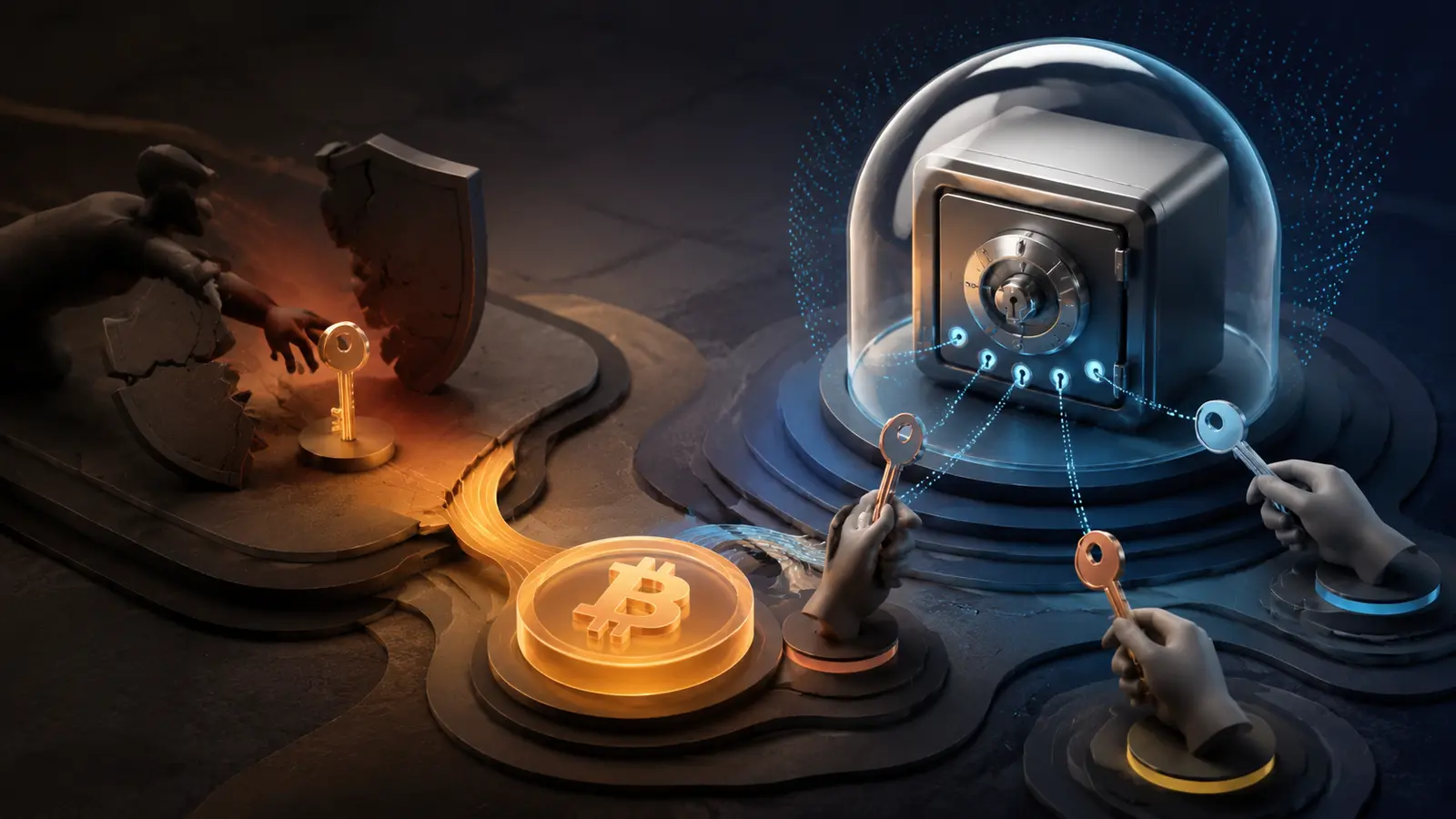
A multisignature Bitcoin wallet requires a specified combination of keys to authorize spending. A two-of-three arrangement, for example, can be designed to tolerate the loss of one key without allowing a single key holder to spend alone. That protection comes with operational complexity. The signing policy, backup information, and recovery process matter just as much as the number of devices involved.
What a Multisig Wallet Is
A standard Bitcoin wallet is what we call a single-signature wallet. Just one private key—or one seed phrase that generates that key—is all it takes to spend your funds. Whoever holds that key controls the money. Period.
That simplicity is great. It’s the reason standard hardware wallets are so easy to set up and use right out of the box. But it’s a double-edged sword. If you lose the key, your funds are likely gone forever. If someone steals the key, they can take your money. If someone corners you and forces you to sign a transaction, there are basically no roadblocks to stop them.
A multisig wallet completely changes the rules of the game. Instead of giving one key absolute authority, the wallet is built using several different keys. A transaction only goes through when a specific number of those keys approve it.
The easiest way to wrap your head around it is to picture a bank vault with multiple locks. A single key won’t open the heavy steel door. Two people, two separate devices, or two different backups have to come together before anything can be moved. And the best part? Bitcoin enforces this rule using pure math and cryptography, not through some bank manager's policy or an outsourced customer service department.
When people talk about multisig, they usually throw around the term M-of-N.
- N is the total number of keys associated with the wallet.
- M is the minimum number of keys required to spend the money.
A 2-of-3 multisig is the gold standard for personal setups. You have three keys in total, but any two of them can authorize a transaction. This means one key can be lost, damaged, or temporarily out of reach, and you still aren't locked out. At the same time, if a thief manages to steal one key, they still can’t touch your Bitcoin.
Of course, you can mix and match. A married couple might opt for a 2-of-2 wallet if they want both partners to sign off on every purchase—though it's worth noting that this leaves zero margin for error if a key gets lost. A business or family office might use a 3-of-5 or 4-of-7 setup, ensuring several board members have to agree before moving company funds. The right setup really just depends on who is involved, how much money is on the line, and what specific risks keep you up at night.
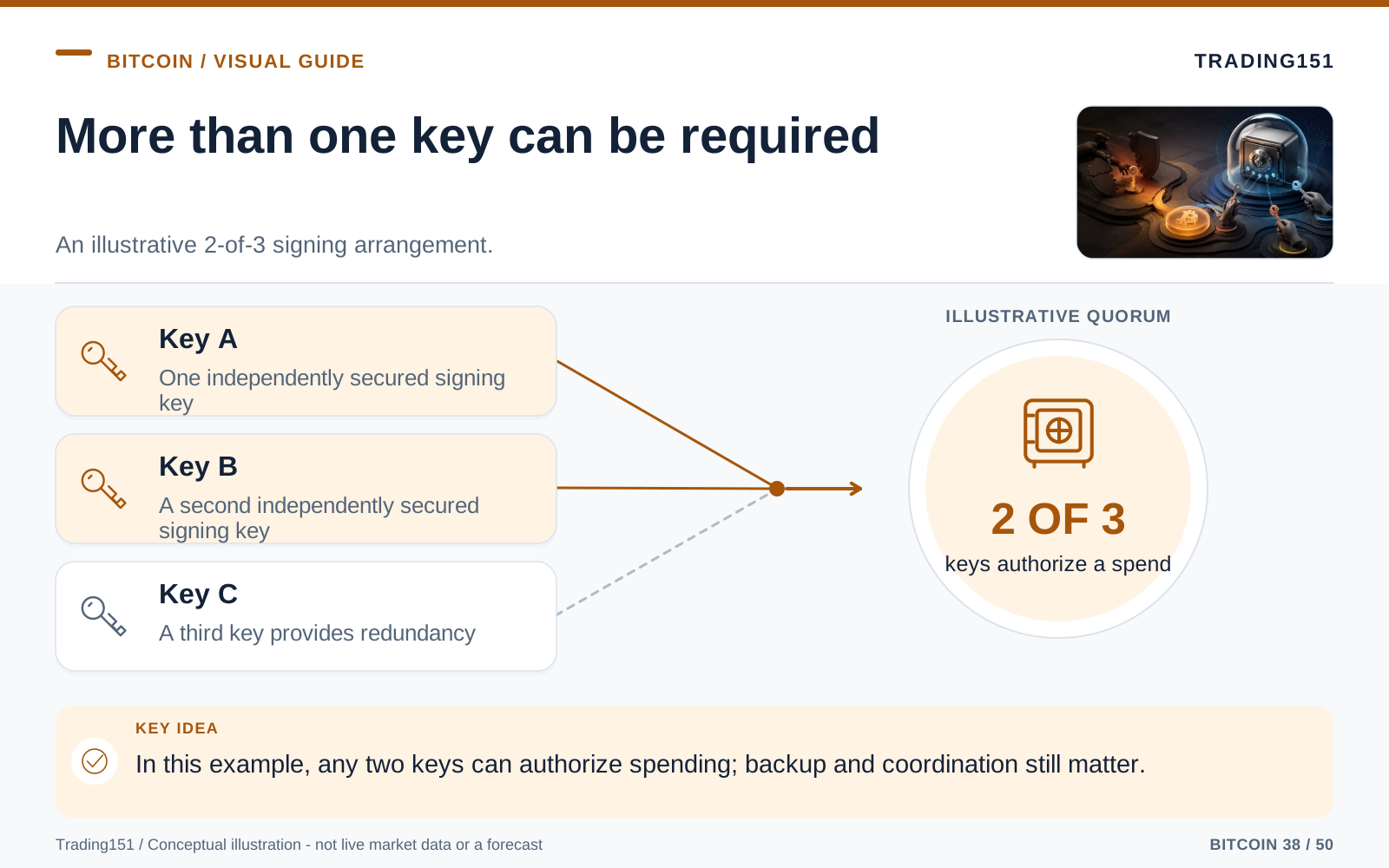
Read this diagram as text
- Key A
- One independently secured signing key
- Key B
- A second independently secured signing key
- Key C
- A third key provides redundancy
The Problem Multisig Solves
The main goal of multisig isn’t to make Bitcoin feel overly complicated. It’s to eliminate the concerning fragility of having your entire net worth depend on a single, fragile secret.
Imagine you’re using a standard hardware wallet with just one backup of your seed phrase. You can definitely beef up your security using metal plates, clever hiding spots, and heavy fireproof safes. And yes, those things absolutely help. But the underlying architecture hasn't changed: one secret still unlocks everything.
With a 2-of-3 multisig, the entire landscape of your risk shifts. You could keep one key at home, stash another in a bank safe deposit box, and leave the third with a trusted family member or a professional custody service. Suddenly, no single location holds enough puzzle pieces to move your funds. A house fire is survivable. A burglary is survivable. Misplacing a backup is definitely annoying, but it’s no longer a financial death sentence.
That is the true beauty of multisig. It transforms custody from an all-or-nothing tightrope walk into a robust system that leaves room for normal human error.
A Simple 2-of-3 Example
Let's say Alice wants to lock down her long-term Bitcoin savings. She decides to create a 2-of-3 multisig wallet using three separate hardware wallets. Keep in mind, the three keys are only one piece of the puzzle. The wallet also needs to know the public keys, the order they go in, the signing threshold, and a few other technical details to function properly. Modern wallets usually package this info in what’s called a descriptor or configuration file. If she loses this file, her Bitcoin isn't necessarily gone as long as she still has her seed backups, but recovering it becomes a large, headache-inducing chore. A proper multisig backup separates the highly secret signing keys from the public "map" that tells her software how the wallet was wired together.
- Key A stays securely at Alice's house, protected by a PIN on her device and backed up on a steel plate.
- Key B is locked away in a safe deposit box across town.
- Key C is handed over to a highly trusted sibling living in a different city, sealed in an envelope with clear instructions.
When Alice wants to move some funds, she just signs the transaction using Key A and Key B. She doesn’t even have to bother her sibling. But if her house burns down and Key A is turned to ash, she can use Key B and Key C to recover her money. If a burglar breaks into her house and steals Key A, they can’t do a thing with it because they only have one out of the two required keys.
Is this setup invincible? No. Nothing is. But it forces an attacker to successfully compromise multiple locations, multiple devices, or multiple people all at once. Crucially, it gives Alice a reliable path to recovery when real life inevitably gets messy.
Why Multisig Feels Different From a Strong Password
It’s tempting to compare Bitcoin security to regular password management, but that analogy falls apart pretty quickly. If you forget your online banking password, you just hit "reset." If you get locked out of an exchange, you can usually jump through a few KYC hoops with customer support to get back in. Bitcoin self-custody doesn't work like that. There is no IT admin, no help desk, and no manager to bail you out if you mess up.
That absolute finality is what makes Bitcoin so powerful, but it’s also what makes holding it yourself so emotionally exhausting. Multisig offers a huge relief because it doesn’t force one person, one notebook, or one thumb drive to carry the entire weight of your wealth.
Setting it up feels less like memorizing a convoluted password and more like designing a secure, foolproof household system. You’re consciously deciding who has authority, what the backup plan is if something goes missing, how your loved ones can access the funds if you're gone, and exactly how many hoops a thief would have to jump through to steal from you.
The Main Benefits of Multisig
1. It Removes the Single Point of Failure
In a single-signature wallet, one seed phrase is all it takes to drain the account. You might guard that phrase with your life, but it’s still a single point of failure. Lose it, and you lose your money. Let it slip, and someone else takes your money.
In a thoughtfully designed multisig setup, one compromised key isn’t enough to hurt you. One lost key isn’t the end of the world. This built-in redundancy is exactly why so many long-term holders eventually graduate to multisig once their stack gets too large to comfortably trust to a single secret.
2. It Makes Physical Theft Much Harder
If a thief finds a single seed phrase, their job is easy: import it into a wallet app and sweep the coins. But if a thief finds just one key from a 2-of-3 wallet? They’ve got a major problem. They still need a second key, plus enough metadata about the wallet to construct a valid transaction.
That extra friction is everything. In the security world, the goal is often to buy time, create confusion, and make the attack so frustratingly difficult that it’s no longer worth the payoff. Multisig accomplishes all three of those things when you separate your keys properly.
3. It Reduces the Risk of Coercion
In the Bitcoin community, people sometimes joke about the "$5 wrench attack"—a grim way of describing someone beating your passwords out of you. The strongest encryption on earth won't save you if you're being physically threatened to hand over your seed phrase.
Multisig makes this nightmare scenario a lot less straightforward. If you only keep one key at your house, you cannot move the funds on demand, even if you want to. The second key might be sitting in a bank vault, held by your lawyer, or managed by a collaborative custody partner with strict security protocols. While it doesn't make you completely immune to danger, it stops an attacker from getting instant gratification just by intimidating one person in their living room.
4. It Works Well for Shared Control
Businesses, charities, investment funds, and families face a totally different challenge than solo investors. They actively don't want one single person to have the power to move funds on a whim.
A corporate treasury might use a 3-of-5 wallet distributed among key executives. A charity might require a combination of two officers and a board member to authorize large transfers. A family might arrange things so that the parents and a trusted financial advisor have to coordinate to tap into the savings. Multisig is the perfect tool for enforcing these kinds of checks and balances without relying on a bank's permission.
5. It Can Make Inheritance Less Fragile
Passing down Bitcoin is notoriously tricky. If you die and leave behind a single seed phrase, whoever finds it first essentially gets the money—whether they were supposed to or not. If you hide it too well, your heirs might never find it at all.
Multisig lets you design a much smoother inheritance plan. You can distribute keys among family members, an estate lawyer, and a secure vault. While you're alive, you maintain total control with your own personal keys. When you pass away, the keys held by your executor and your heirs can be combined to unlock the funds, ensuring the Bitcoin goes exactly where you intended.
What Multisig Does Not Solve
Multisig is an incredible tool, but let's be clear: it is not a magic fix for sloppy security. In fact, if done poorly, it can make things worse.
The biggest trap people fall into is assuming that simply adding more keys automatically equals more safety. That just isn’t true. A messy 2-of-3 setup—where nobody remembers which key is stored where, and the wallet configuration file is nowhere to be found—is infinitely more dangerous than a basic, single-signature wallet that you’ve managed carefully.
Multisig is designed to protect you from specific failures, not every conceivable disaster. You still need crystal-clear backups, a solid recovery plan, hardware that works, and the sheer discipline to test your setup before you start trusting it with serious money.
The Wallet Configuration File: The Part People Forget
In a standard single-signature wallet, your seed phrase is the ideal. With multisig, the keys are obviously important, but they are only half the story.
A multisig wallet also completely relies on a blueprint that describes exactly how the wallet was built. Depending on the software you use, this might be called a wallet configuration file, a descriptor, a coordination file, or an export file. It holds the public information about your keys and the specific spending rules—like the fact that it’s a 2-of-3 setup, along with the extended public keys associated with it.
Now, this file alone usually isn’t enough for someone to steal your Bitcoin, because it doesn’t contain the actual private keys. But it is vitally important. If you lose it, trying to reconstruct your wallet later can be a stressful, confusing nightmare, especially if you aren’t deeply technical.
A bulletproof multisig backup plan doesn't just protect the private keys; it also includes copies of that wallet configuration. You should store a copy of the configuration with each key, or in several clearly labeled, safe locations. Treat it as sensitive privacy information—because it does reveal exactly how your wallet is structured and which addresses are yours—but don't confuse it with a private key.
The Real Trade-Offs
Setup Takes More Care
You can get a basic hardware wallet up and running in ten minutes. A proper multisig setup asks for a bit more patience. You’re going to be initializing multiple devices, writing down multiple backups, verifying addresses across different screens, exporting public key data, saving the configuration file, and—crucially—running a test recovery.
None of this is rocket science. But it absolutely requires a calm afternoon, a solid checklist, and zero distractions. Multisig is not something you should try to set up while you're exhausted, half-watching TV, or rushing to catch a flight.
You Can Still Lose Access
A 2-of-3 wallet is designed to survive one lost key. It cannot survive two. If two of your keys go missing, get destroyed in a flood, or somehow become unreadable, those funds are likely gone forever. The same tragic outcome applies if you're the only person who understands how the setup works and you suddenly aren't around anymore.
Because of this, your storage plan needs to be almost boring in its clarity. Every key should be labeled in a way that makes obvious sense, without giving away too much to a stranger. Every hiding spot should be documented appropriately. Your recovery process needs to be easily understood by your future self—not just the highly caffeinated version of you who set it up on a productive Sunday afternoon.
Spending Is Slower on Purpose
If you're looking for a wallet for daily spending or quick trading, multisig is going to drive you crazy. When two keys live in completely different physical locations, moving funds might require a drive across town, a phone call, or scheduling time with another person. That friction is exactly what you want for deep, long-term savings, but it’s annoying for small, everyday transactions.
This is why most people use a layered approach: a mobile wallet with a small balance for spending money, a single hardware wallet for moderate savings, and a multisig cold-storage vault for the life-changing money they absolutely cannot afford to lose.
Fees and Privacy Depend on the Type of Multisig
Under the hood, traditional on-chain multisig transactions take up more data space than a simple single-signature transaction because they require multiple signatures. Because they are "heavier" in terms of data, they usually cost a bit more in network fees—especially when the Bitcoin network is congested.
Newer tech like Taproot and multi-signature schemes such as MuSig2 are starting to change this, making cooperative multi-party spends look and cost exactly the same as ordinary single-key spends. That’s a huge step forward for privacy and efficiency. However, wallet and hardware support for these newer standards is still a bit all over the place, and many people still rely on older, battle-tested multisig formats. The practical takeaway here? Know exactly what your specific wallet supports, rather than blindly assuming every multisig setup has the same privacy and fee structure.
Complexity Can Become Its Own Risk
The strongest, most impenetrable vault in the world is totally useless if the owner forgets the combination. Your multisig setup needs to fit your actual life, your daily habits, and your honest level of technical comfort. If you design a convoluted security maze that only makes sense after reading three Reddit threads and a notebook full of acronyms, you are laying the groundwork for a future disaster. Multisig usually fails at the human edges: storing two devices in the same drawer, leaving backups completely unlabeled, relying on a secret passphrase you never wrote down, leaving heirs who don't even know what software to download, or doing a test transaction without ever testing the recovery.
Every signer you add is another moving part you have to maintain. The best defense is rehearsal. Build the vault, fund it with a tiny amount of money, pretend you lost a key, restore it from your documented backups, and successfully spend the money before you load it up with your life savings. A security setup isn’t robust just because the diagram looks cool; it’s robust because you’ve proven you can recover it.
Good security feels sturdy, not mysterious. You should be able to explain your emergency recovery plan in plain English to the people who might need to use it one day.
DIY Multisig vs. Collaborative Custody
When it comes to multisig, you generally have two paths: build and manage the entire thing entirely by yourself, or team up with a collaborative custody provider. A provider can hold one of your keys, help you coordinate transactions, keep an eye on the wallet, and guide you through a messy recovery, all while being completely unable to spend the money without you. It takes a huge technical weight off your shoulders without forcing you to hand over full custody. The catch? It introduces reliance on a third-party service, slightly reduces your privacy, comes with fees, and carries the risk that the company might go out of business or change their terms. Always make sure you know if you can rebuild and empty your wallet using standard, open-source tools if the company vanishes tomorrow. True assistance is valuable; permanent vendor lock-in is a trap.
In a fully DIY setup, you create the wallet, hold all the keys, stash the configuration file, and manage the recovery totally solo. You get maximum independence. But it also means every mistake is 100% on you to fix.
Collaborative custody is the middle ground. In a typical 2-of-3 setup, you hold two keys and the provider holds one. You can still move your funds completely independently because you hold the majority of the keys. But if you screw up and lose one of your keys, you can call the provider, verify your identity, and they will use their key to help you recover your money.
For many, this is the sweet spot. You aren’t giving up control like you do on an exchange, because the company can never spend the funds on their own. But you get customer support, user-friendly software, a safety net for recovery, and often some much-needed help with inheritance planning.
The trade-off, of course, is that you now have a relationship with a corporate entity. They will likely know who you are and how much Bitcoin you have. They will charge you for the service. They might introduce policies you disagree with. They might even go out of business. A responsible collaborative custody setup will always provide you with an "escape hatch"—a way to recover your funds completely independent of the company using the keys and files you already possess.
When Multisig Makes Sense
Multisig is seriously worth looking into once the amount of money you're protecting gets large enough that the idea of a single point of failure makes you lose sleep. That threshold is different for everybody. For one person, it might be a few thousand dollars; for someone else, it might be a decade of life savings.
It’s also an absolute must when more than one person needs a say in how funds are spent. Married couples, business partners, corporate boards, family offices, and investment teams can use multisig to mathematically ensure nobody can go rogue and move funds unilaterally.
Finally, it’s a brilliant solution when you want to spread your risk out geographically. A house fire, a local break-in, or a single compromised safe deposit box should never have the power to wipe out your entire financial future.
But most importantly, multisig only makes sense if you are willing to maintain it. The job isn’t done on day one. You have to periodically check on your devices, review your instructions, update your plan when you move or relationships change, and make absolutely sure your heirs or business partners aren’t going to be left staring at a cryptographic puzzle they can't solve.
When Multisig May Be Overkill
If you're only holding a small amount of Bitcoin, multisig is probably more of a headache than it's worth. A standard hardware wallet with a carefully hidden backup is usually plenty. If you need to move your funds frequently, the built-in friction of multisig will quickly drive you insane. And if you are brand new to Bitcoin, diving headfirst into multisig is a great way to overwhelm yourself before you even grasp the basics.
There is absolutely no shame in keeping things simple. Nine times out of ten, a simple, well-understood security plan will beat an advanced, poorly understood one. Your goal isn’t to flex on the internet about how complex your vault is. Your goal is to secure your wealth in a way you can confidently manage.
Best Practices for Doing Multisig Well
Use Separate Hardware Wallets
If you’re setting up a 2-of-3 wallet, it’s a smart move to use devices from completely different manufacturers. Why? It massively reduces the chances that a single hardware flaw, a buggy firmware update, a supply-chain hack, or even just a confusing user interface ruins all your keys at the same time.
You don’t need to get overly exotic with it. The goal is just diversity: different devices, different backups, different locations.
Separate the Keys Geographically
Keeping all three of your keys tucked away in the same desk drawer entirely defeats the purpose of multisig. A fire, a break-in, or even a highly curious houseguest could compromise the whole setup in one go. Spread the keys out across physical locations that don’t share the same risks.
Your home, your office, a bank safe deposit box, a trusted relative's house, an attorney's office, or a custody partner are all valid options. Just remember that every location has trade-offs. A bank vault is secure, but you can only get to it during banking hours. A family member might be super convenient, but maybe they aren't as organized or careful as you’d like. Choose based on what works for your life.
Label Everything Clearly
Trust me, "future you" is not going to remember every little detail of this setup. And your spouse, executor, or business partner will remember even less. You need to label your keys and backups clearly enough that the recovery path makes sense, but not so obviously that a random snooper can immediately figure out your entire security setup.
For example, labels like "Vault Key 1 of 3" and "Multisig Recovery Instructions" are way more helpful than some cryptic code name that only makes sense to you today. And please, store the sensitive recovery instructions where they belong—don't just tape them to the back of the device.
Back Up the Wallet Configuration
Do not skip this step. Keep multiple copies of your wallet configuration file (or descriptor). Keep one with the keys, and consider stashing an extra copy somewhere safe. While it doesn’t require the same level of top-secret paranoia as a seed phrase, losing it will make recovering your Bitcoin a large, unnecessary headache.
Practice Before Sending Serious Money
Build the wallet. Send a tiny test amount of Bitcoin to it. Then, try spending it back out. Practice signing transactions with different combinations of your keys. Double-check that you can fully restore the wallet from your backups and configuration file alone. You should only ever transfer meaningful funds after you’ve proved the whole process works.
Yes, this part feels tedious. But this is exactly when you want to catch mistakes—when the stakes are a few bucks, not your life savings.
Write an Emergency Plan
A truly bulletproof multisig setup includes physical, written instructions for emergencies. What happens if a key goes missing? What if a hardware wallet breaks? Who should your family call if something happens to you? Where is the configuration file? What specific software did you use to build the wallet?
Write the plan out simply and plainly, so a reasonably capable non-expert could follow it (perhaps with some professional help). Don’t turn your estate plan into a riddle or a treasure hunt.
Review the Setup Once or Twice a Year
Life happens. People move to new cities. Banks shut down branches. Hardware wallets get major updates. Relationships end. A custody plan that looked absolutely perfect three years ago can quietly become a disaster waiting to happen.
Set a calendar reminder to review your multisig setup every six months to a year. You don’t need to move any coins. Just physically check that the keys are still where you put them, read over your instructions to make sure they still make sense, and confirm that the people involved are still the people you want involved.
A Practical Setup Checklist
- Decide what the wallet is for. Are you holding long-term savings, setting up family inheritance, securing a business treasury, or sharing custody? Each goal requires a slightly different approach.
- Choose the signing policy. For solo investors, 2-of-3 is the standard sweet spot. If you're organizing a group, think carefully about continuity and governance.
- Select the hardware and software. Confirm that your wallet software supports your chosen devices and provides an easy way to export the wallet configuration.
- Create each key separately. Treat each backup carefully—write the seed words on durable material, and absolutely never photograph them or store them in the cloud.
- Build the multisig wallet. Always verify receiving addresses directly on the hardware devices themselves, not just on your laptop screen.
- Save the wallet configuration. Save copies in more than one place, and firmly tie them to the correct wallet so they don't get mixed up later.
- Send a small test transaction. Start small. Make sure the funds arrive exactly where they are supposed to.
- Test spending and recovery. Run a drill. Sign transactions with the required keys, and test multiple combinations if your setup allows it.
- Document the recovery process. Write clear, step-by-step instructions that a trusted person could follow if you weren't around to help.
- Only then move larger funds. Once you've thoroughly tested the system, and only then, move the real money.
Common Mistakes to Avoid
- Storing all keys together. You've just turned multisig into a very complicated single point of failure. Don't do this.
- Losing the wallet configuration. Yes, private keys are the star of the show, but the configuration file is the map that tells your software how all the pieces fit together.
- Using a setup nobody else can understand. If your heirs or business partners ever need access, they need a clear path, not a requirement to read your mind.
- Skipping the test transaction. Never, ever send serious wealth to a wallet you haven’t successfully practiced spending from.
- Forgetting about privacy. Depending on how it's implemented, multisig can reveal a lot about how your wallet is structured. Pay attention to address reuse and be smart about where you store your configuration files.
- Assuming a custody provider is magic. Collaborative custody is awesome, but you still need to know exactly what happens to your Bitcoin if that company shuts its doors.
The Human Side of Self-Custody
We spend a lot of time stressing over the technical mechanics of multisig, but the human element matters just as much, if not more. Your custody plan has to live in the real world. It has to survive stress, grief, international travel, simple forgetfulness, messy family dynamics, and the ordinary chaos of moving boxes from one closet to another.
A good multisig setup should make you feel calm and secure. It shouldn’t make your daily life feel like an exhausting espionage thriller. If you’re constantly stressed that you’ve made your security plan too clever for your own good, take that as a sign to simplify things.
The best security plans are shockingly boring. They are well-documented. They are thoroughly tested. They are easy to understand. They rely on smart redundancy rather than heroic feats of memory. Multisig gives you the exact tools you need to build that kind of plan, but it still requires you to be direct about your real-world risks.
A backup needs the wallet map as well as the keys
Begin by naming the failure the arrangement is meant to withstand. Three keys kept in the same bag do little to protect against losing that bag. Three backups controlled through the same cloud account share another point of failure. Separation should address a realistic risk without making ordinary use so difficult that the owner abandons the procedure.
Keep the wallet's configuration information available securely. Depending on the software and format, recovery may require descriptors or equivalent data identifying the participating public keys, derivation paths, and signing policy. Possessing enough seed phrases without knowing how the wallet was constructed can make recovery more difficult. Follow the wallet's documented export and restoration process.
Test a small receipt and spend before moving a substantial balance. Verify that the intended signing combination works and that a recovery can be performed without relying on the original computer. The test should use the real policy, not a simplified demonstration that omits the very device or service expected to be unavailable in an emergency.
Plan for incapacity and succession without giving unnecessary access during ordinary life. A trusted person may need instructions about where records are stored and whom to contact, but not unrestricted possession of every key. Legal ownership and technical ability to spend are separate questions. A sound arrangement addresses both, with professional advice where the estate or organizational requirements warrant it.
Separate loss scenarios from theft scenarios
A multisig arrangement should be tested against more than one kind of failure. Losing one device, losing an entire location, and compromising a co-signer are different events. Keeping several keys in the same place may protect against a single device failure while doing little against theft or fire.
Map which combinations remain available after each plausible event. Include the wallet configuration and recovery information, not only the signing keys. Then consider who can help an authorized person reconstruct the wallet without learning enough to spend alone. The design should reflect the actual household or organization. Adding more keys can increase resilience, but it can also create a complicated process that people cannot maintain or recover when circumstances change. 1, 2, 3
Shared Control, Carefully Designed
Upgrading from a single-signature wallet to multisig isn’t just a technical shift. It’s a total change in mindset.
With a basic wallet, the only question is: "Where do I hide the secret?" With multisig, you get to ask a much better question: "How do I design a system that survives when something inevitably goes wrong?"
That psychological shift is powerful. It means a house fire doesn’t have to ruin you financially. A stolen device doesn’t have to be fatal. A forgotten hiding spot doesn’t have to erase years of hard work. It also means your family, your business partners, or even just "future you" will have a clear, reliable path forward when life gets difficult.
Multisig isn’t right for every wallet or every person. It undeniably requires more care, more documentation, and more testing than a basic setup. But for serious, long-term Bitcoin storage, it offers something rare in the world of self-custody: breathing room.
Bitcoin gave individuals the unprecedented ability to hold wealth without asking for anyone's permission. Multisig simply helps make that large responsibility much more resilient. When used thoughtfully, it transforms self-custody from a single fragile secret into a durable, multi-generational plan.
And for a lot of people, that’s the difference between merely owning Bitcoin and finally sleeping well while you hold it.
Sources and further reading
- Bitcoin.org: Securing your wallet
- Bitcoin BIP 380: Output Script Descriptors
- SEC Investor Bulletin: Crypto Asset Custody Basics for Retail Investors
Editorial revision: 7 October 2026. Numerical scenarios are hypothetical unless identified as historical. References support the added explanations and selected corrections; rules and product terms should be checked again before acting.