
Trading mistakes become easier to address when they are specific. "Be more disciplined" is hard to act on; "stop increasing position size after a loss" gives you something observable. A review should distinguish an ordinary losing trade from a broken rule, an unrealistic assumption, or a strategy with no demonstrated advantage. They require different responses.
1. Trading Without a Real Plan
Most traders swear they have a trading plan, but if you press them on it, what they really have is a loose set of preferences. A real plan isn't a motivational sticky note on your monitor; it's a strict set of instructions. It needs clear setup criteria, a position-sizing rule, an exact point where you admit you're wrong, profit targets, rules for when not to trade, and a routine for reviewing your days. When your rules only live in your head, they have a funny way of shape-shifting to justify whatever impulsive trade you want to take right now.
It usually goes like this: "I like trading EUR/USD. I usually play bounces off support and resistance. I kind of prefer the London session, and I try to keep my risk small." That’s not a plan. That’s just a vibe.
A legitimate trading plan is so specific you could hand it to a stranger and they could trade it for you. It dictates your pairs, the timeframes that matter, the exact trigger you need to enter, where your stop goes, how big your position is, where you take profits, and—crucially—when you walk away. It also spells out what a bad day looks like so you know when to close the laptop.
Without that rigid structure, the market will just toss your emotions around all day. A big green candle makes you feel bullish and greedy. A red one makes you sweat. A tiny pullback feels like a disaster, and a sudden breakout gives you large FOMO. You spend the whole session reacting instead of executing.
And that’s the real danger of flying by the seat of your pants: you don't just become inconsistent, you become easily manipulated. Not by some secret market-maker conspiracy, but by normal, everyday price noise. Without a framework to filter out the junk, every little tick on the chart suddenly feels important.
The Fix: Write your plan down. Put it in plain English. Keep it simple enough that you can follow it when your heart is beating fast. Turn it into a literal checklist you run through before clicking buy or sell. If a setup doesn’t tick all the boxes, you sit on your hands. Yes, it sounds boring. But eventually, you realize that profitable trading is supposed to be a little boring.
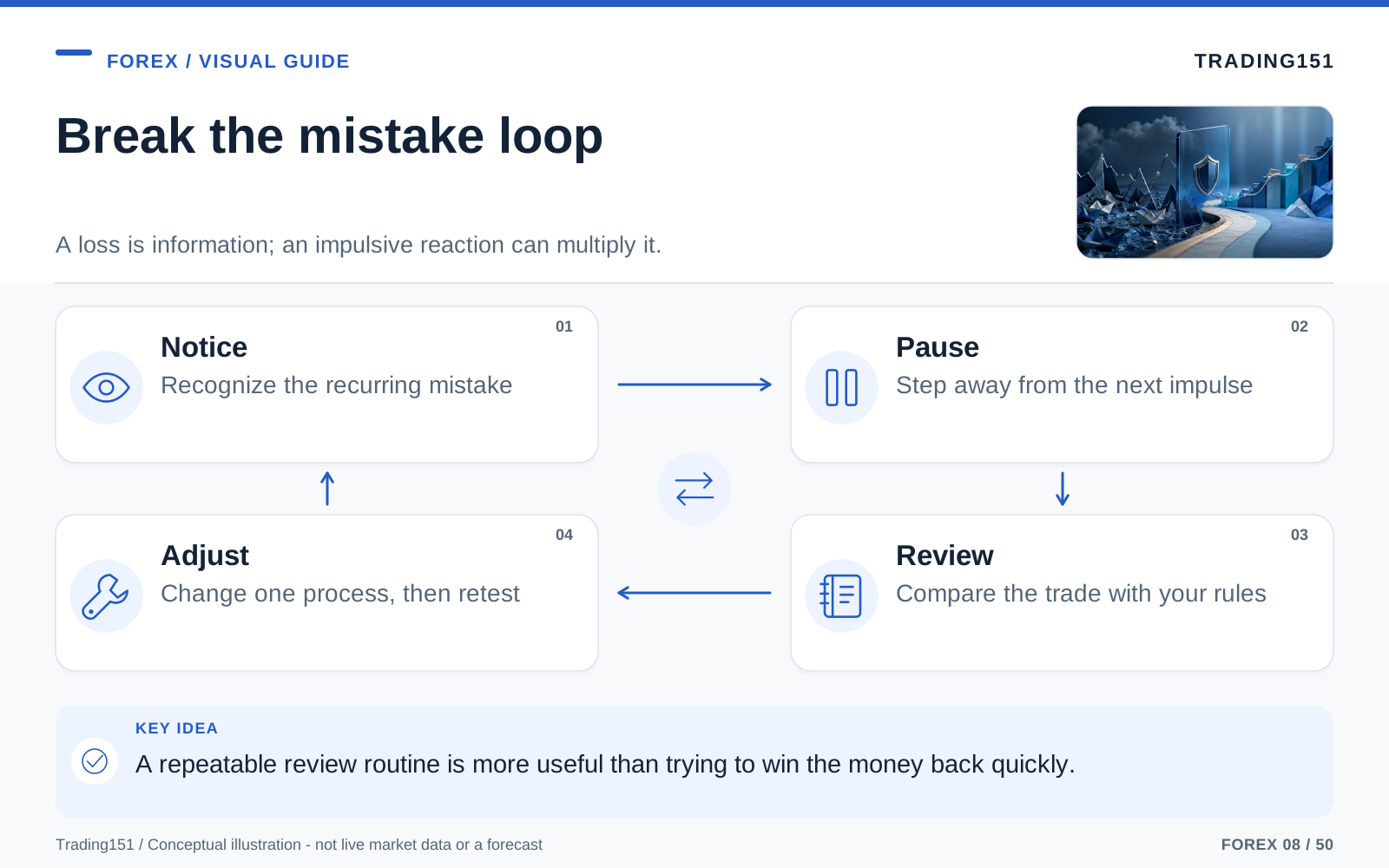
Read this diagram as text
- Notice
- Recognize the recurring mistake
- Pause
- Step away from the next impulse
- Review
- Compare the trade with your rules
- Adjust
- Change one process, then retest
2. Risking Too Much on a Single Trade
This single habit destroys more accounts than bad strategies ever could. Risking too much usually starts because a trader is focused on how much money they want to make, rather than what the market is doing. They pick a large position size to hit a specific dollar goal, and then awkwardly shove their stop-loss wherever they need to so the math kinda-sorta works out. That's totally backwards. You need to find your invalidation point first, figure out how much you can comfortably lose, and then calculate your size. An uncomfortable risk doesn't magically become safe just because you really like the setup.
Maybe you’ve had a killer week and feel like you can’t lose. Or maybe the setup just looks so perfect that going heavy feels justified. Sometimes, it’s just the desperate urge to make back yesterday's severe loss in one fell swoop. Whatever the trigger, the internal lie is always the same: this trade is a sure thing.
Spoiler alert: the trade is almost never as much of a "sure thing" as you think it is.
It doesn't matter how flawless your markup is; you are still playing a game of probabilities. The market can whip around on a random news headline, a central banker coughing, a surprise data drop, or just everyday volatility. The second you risk an amount that makes your stomach drop, your brain stops working properly. You start staring at the 1-minute chart, agonizing over every pip. You panic and close early. You freeze and hold too long. You start hoping and praying instead of trading.
Good risk management sounds mind-numbingly simple, which is exactly why beginners ignore it. But the guys who stick around long enough to make a living all figure out the same thing: protecting your downside is the only way you survive long enough for your strategy to work.
The Fix: Pick a hard risk limit per trade—usually around 1% of your account—and treat it like law. The specific percentage matters less than your religious adherence to it. Your goal isn’t to hit a home run on one trade. Your goal is to guarantee that no single loss has the power to ruin your entire month.
3. Using Leverage Like It's Free Money
Leverage is fun right up until the exact moment it ruins your day.
When you're just starting out, it feels like a cheat code. You have a tiny account, but with huge leverage, suddenly you can trade like the big dogs. A tiny little move can double your money. It’s intoxicating.
The severe reality is that leverage is a double-edged sword, and it doesn't care which way it cuts. It magnifies your mistakes just as aggressively as your wins. A tiny miscalculation becomes a catastrophic loss. A perfectly normal pullback blows your account to zero. One impulsive click can put you in a financial hole so deep that you spend weeks revenge trading just to get back to breakeven.
Rookies often confuse access with obligation. Just because your broker offers you 500:1 leverage doesn’t mean you have to use it. When you over-leverage, normal market breathing feels like a heart attack. You can't read the chart clearly anymore because your large position size is doing all the thinking for you.
The Fix: Keep your position sizes reasonable enough that you can watch the price bounce around without having a meltdown. Use leverage as a tool to take multiple responsible positions, not as a shortcut to get rich by Friday. If a setup is only tempting because you're using max leverage to force a big payout, it’s not a good setup. It’s just a gamble.
4. Revenge Trading After a Loss
We’ve all been there. You take a loss, and it doesn't just hurt your wallet—it hurts your pride. But relying purely on willpower to stop yourself from diving right back in rarely works. You need actual friction between a loss and your next trade, because willpower completely evaporates the second you get angry. A practical safeguard, like locking yourself out of your platform, is infinitely more reliable than promising yourself you'll "stay calm" next time.
When a trade goes south, it often feels like a personal attack. Maybe the setup was absolutely textbook. Maybe you did everything right, followed every rule, and still caught a stop-out. Or worse, maybe the price tagged your stop by a single pip and then immediately rocketed to your target. It feels insulting.
That’s exactly when revenge trading starts whispering in your ear.
You’ll try to convince yourself that you're just "taking the next valid setup," but deep down, you know you're just pissed off. You want your money back. You want to force the market to admit you were right all along. So, you jump right back in—usually with terrible timing, way too much size, and zero actual analysis.
The scariest thing about revenge trading is how logical it feels in the heat of the moment. You don't feel emotionally unstable; you just feel a sudden, burning urgency to act. Then that second trade loses, too. And before you know it, you’re caught in a total downward spiral.
The Fix: Build a physical circuit breaker into your routine. After a full loss, force yourself to walk away from the screens. Maybe it’s for 20 minutes, maybe an hour, or maybe you're done for the day. If you drop two trades in a row, shut the platform down. Walking away isn't weakness. In fact, knowing when to fold your laptop is the most professional thing you can do.
5. Constantly Switching Strategies
Welcome to the classic beginner doom loop: you learn a new strategy, get hyped about it, win a few trades, hit your first losing streak, completely abandon the strategy, and start hunting for a "better" one.
And the cycle repeats. You jump to a new method with completely different indicators, a new YouTube guru, different timeframes, and a fresh set of buzzwords. You swear by simple price action for a week. Then you get obsessed with "smart money concepts" and order blocks. Then it's MACD divergence. Finally, you end up buying some flashy indicator that promises an "87% win rate" and zero losses.
Curiosity isn't the problem here—curiosity is great. The problem is that you never stick with one single approach long enough to figure out how it works.
Every strategy on earth goes through periods of drawdown. Every system has market conditions where it crushes it, and conditions where it gets chopped to pieces. If you bail the second things get uncomfortable, you’ll never gather enough data to know if the strategy sucks, or if you just hit a totally normal rough patch.
Though: sometimes strategy-hopping is just a defense mechanism. It gives you an excuse to avoid the grueling work of journaling, practicing discipline, and owning your mistakes. It's so much easier to blame a "failed system" than it is to admit you just couldn't follow your own rules.
The Fix: Pick one strategy that makes sense to your brain, and stick to it. Commit to trading it over a large sample size. Not five trades. Not just until you have a red week. Trade it long enough to intimately understand its quirks, its weaknesses, and its sweet spots. Real mastery comes from digging a deep well, not a hundred shallow puddles.
6. Ignoring News and the Bigger Market Context
Technical analysis, perfect entries, and market structure are absolutely vital, but none of them exist in a vacuum.
You can map out a flawless zone, wait patiently for price to tap it, and get a gorgeous rejection candle—right before a large CPI report comes out and completely nukes your trade. Suddenly the spread goes wild, the chart looks broken, and the beautiful setup you loved three minutes ago is now a large red number in your account.
It's shocking how many traders have to learn this the hard way. They get so zoomed in on 5-minute chart patterns that they completely forget currencies are tied to actual countries, real-world policies, and global events. Interest rate hikes, inflation data, jobs reports, and even a random geopolitical tweet can flip the entire mood of the market in a fraction of a second.
You don’t need an economics degree to be a good Forex trader. But acting like the fundamentals don’t matter is like driving 100 mph in a blizzard and insisting you’ll be fine just because you have nice tires.
The Fix: Make the economic calendar your best friend. Check it every morning before you even open your charts. Know exactly when the big red-folder events are dropping, especially for the pairs you trade. If you decide to hold a trade through major news, do it on purpose—not because you were too lazy to check. Bookmark sites like Forex Factory or Investing.com and use them.
7. Moving the Stop-Loss Because You "Need More Room"
This specific mistake is purely driven by emotion, even though it always disguises itself as "logic."
You get into a trade with a totally reasonable stop-loss. But then price starts creeping against you. Not a fast crash, just a slow, agonizing bleed that makes you sweat. That’s when the mental gymnastics begin. Maybe my stop is just a bit too tight. Maybe the big banks are just hunting liquidity before it reverses. I just need to give this level a little more room to breathe.
And just like that, to make the anxiety stop, you drag your stop-loss further down.
And you rarely do it just once. Once you cross that psychological line, the floodgates open. What was supposed to be a tiny, paper-cut loss turns into a medium loss. Then a large one. Eventually, your original trade idea is completely invalid, but you're still stubbornly holding on because now your ego is on the line and you just can't stomach being wrong.
Widening a stop after you're already in a trade is almost never based on real analysis. It's just pain management. You’re frantically trying to avoid the sting of taking a loss, and you’re paying for that temporary emotional relief with hard cash.
The Fix: Figure out your absolute line in the sand before you click buy or sell, and treat it like a brick wall. If the price crosses it, you are wrong, and the trade is over. No negotiating. No "just five more pips." The only time you should ever touch your stop-loss is to move it into profit or reduce risk. Anything else is just fear taking the wheel.
8. Overtrading Out of Boredom or Restlessness
A lot of people think the job of a day trader is to constantly be trading. They sit down at their desk and feel this overwhelming urge to do something. If they sit flat for an hour, they start feeling like they're wasting their day.
That mindset is an absolute account killer.
The reality is, not every day in the market is going to hand you a golden opportunity. Some days the price action is a choppy mess. Some days it just drifts sideways. Some days a setup looks incredible, but misses your entry by two pips and takes off without you. A professional can shrug that off. An amateur starts forcing garbage trades just to feel the rush of being in the market.
Overtrading isn't always about greed. Usually, it's just plain old boredom. Staring at candles and waiting for hours doesn’t give your brain that sweet dopamine hit. So, your brain starts inventing reasons to enter. The price is close enough to the zone. That candle looks decent. It’s not my A+ setup, but it’ll probably work anyway.
By the time the session closes, you’ve taken three absolute trash trades that you never should have touched, and gave back a chunk of your profits for no reason.
The Fix: You need to fundamentally redefine what a "good trading day" looks like. A good day is not a day where you took five trades. It's a day where you followed your rules to the letter. If the market doesn't serve up anything clean, sitting on your hands isn’t being lazy—it’s playing defense. In this game, patience pays just as much as execution.
9. Unrealistic Expectations About Money and Speed
This is the silent killer that corrupts your decision-making before you even place your first trade.
If you throw $500 into a broker account and expect it to replace your full-time salary in a few months, you are putting a suffocating amount of pressure on every trade. All of a sudden, a totally reasonable 2% gain feels pathetic. A slow, steady strategy feels agonizing. Instead of asking yourself, "Did I execute my plan well today?" you start obsessing over, "Why am I not rich yet?"
That desperate frustration is exactly what pushes people into cranking up their lot sizes, taking sub-par setups, and revenge trading. They don't do it because they're inherently reckless; they do it because their expectations are substantially out of touch with reality. They wanted a fast-pass to millions, and now normal, modest growth feels like a failure.
The honest truth isn't very sexy, but you need to hear it: consistency has to come first. The big money comes later. If you can protect your capital, stick to your rules, and pull steady percentages on a tiny account, you have a real future in this. If you're swinging for the fences before you even know how to hold the bat, you're just going to strike out.
The Fix: Stop looking at the dollar signs and start measuring your progress in terms of skill, discipline, and managing your drawdowns. Think in percentages, not cash. Think in quarters and years, not days. Your goal right now isn’t to squeeze a Ferrari out of a $1,000 account. Your goal is simply to prove to yourself that you can follow a system consistently.
10. Not Keeping a Trading Journal
Journaling sounds like a large chore, right up until you realize how terribly your brain lies to you. A good journal isn't just a list of wins and losses; it’s a mirror. It shows you exactly where you're messing up. Did you follow your plan? Was your lot size right? Were you trading out of FOMO? When you start tracking this stuff, you realize that your random mistakes are predictable habits you can fix.
Without a written record, we build our trading identities purely on emotion. We vividly remember that one time we caught a large 1:5 runner, but we conveniently blur out the five stupid trades we took out of boredom the next day. We tell ourselves things like, "I'm great at trading the open," without ever looking at the data to see if we're just hemorrhaging money before 10 AM.
A solid journal destroys those convenient little lies we tell ourselves. It will clearly show you if you always lose money on Fridays, if you tend to over-leverage after a winning streak, or if you constantly get chopped out of GBP/JPY. It also highlights the good stuff—like uncovering a specific setup you take that almost always wins, even if you never consciously noticed it.
But the best thing a journal does is force you to slow down. Taking five minutes to document a trade forces you to face uncomfortable facts. Why did I click buy? Was this really my A-setup? Or was I just impatient and bored?
The Fix: Keep it simple so you use it. Jot down the pair, the date, your entry, stop-loss, target, risk, and the final result. Most importantly, add a quick note about how you felt during the trade and drop a screenshot of the chart. Review your notes every weekend. I guarantee the answers to your worst trading problems are already sitting in your own data—you just haven't looked for them yet.
11. Treating Trading Like Entertainment Instead of a Business
If there’s one core problem that connects everything on this list, it’s this.
So many newer traders treat the markets like a high-stakes casino game. They open their laptop whenever they feel like it. They take trades based on a "gut feeling." They don't track their numbers. They bounce from strategy to strategy. When they win, they celebrate like they hit the jackpot, and when they lose, they throw a tantrum and blame the market makers.
Pros operate in a completely different universe. Sure, they might love what they do, but they aren't in it for the adrenaline rush. They treat it like a boring, predictable business. They rely on routines, systems, and data. They fully accept that a perfectly good trade can hit a stop-loss, and a terrible, impulsive trade can accidentally make money. They don't care about the emotional thrill of a single trade; they only care about whether they executed their system flawlessly today.
Making that mental shift is a lot less glamorous than the Instagram gurus make it seem. It requires immense repetition, self-restraint, and routine. But that boring, monotonous routine is exactly where long-term profitability lives.
The Fix: Start asking yourself completely different questions. Stop asking, "How much money can I make today?" and start asking, "Did I follow my exact rules today?" Stop wondering, "Was this an exciting trade?" and ask, "Was this trade a logical business decision?" When you treat your trading account like a serious business, you stop blowing it up like a reckless gambler.
Fix one recurring mistake at a time
Suppose ten recent trades include four unplanned entries, three trades placed correctly under the strategy, and three with order-entry errors. Grouping all ten as bad trading hides the problem. The correctly executed trades may simply be part of the strategy's normal variation. The unplanned entries suggest a decision-control issue. The order errors suggest a platform or workflow issue.
Choose one change that addresses the most consequential repeated problem. For order errors, a pre-submission check of size, direction, and stop placement may help. For unplanned entries, a rule requiring a saved setup note before placing the order may add useful friction. For a strategy that loses after realistic costs, stricter discipline alone will not create an edge; the hypothesis needs reassessment.
Measure the behavior separately from profit. A week without order errors is progress even if the valid trades lose money. A profitable week containing the same preventable mistakes is not evidence that those mistakes stopped mattering. This keeps the review from rewarding luck.
Give the change a defined review period without treating the period as statistical proof of profitability. Record whether you followed it and whether it solved the operational problem. A small, repeatable correction is more useful than replacing the entire trading plan every time the account has an uncomfortable week.
Find the first decision that went wrong
A losing trade often ends with a conspicuous mistake, such as moving a stop or doubling the size. The more useful review may begin earlier. Was the trade entered because the setup met the rules, or because the trader was trying to recover a previous loss? Was the position too large before the market moved? Was a scheduled announcement ignored?
Trace the sequence without turning the review into a character judgment. Write down the first point at which the process departed from the plan, then choose a control aimed at that point. A maximum order size addresses a sizing error more directly than a vague promise to be disciplined. A pause after a loss may help with rushed decisions, but it will not repair a strategy that has no evidence behind it.
Keep the intervention small enough to evaluate. Changing five things after every bad day makes it difficult to learn which change mattered. A mistake log should lead to a testable adjustment, not an ever-growing collection of rules that no one can follow consistently. 1, 2
The Part Most Traders Need to Hear
If you’re reading this and feeling called out, take a deep breath. Making these mistakes doesn’t mean you’re a failure. It just means you’re human.
Every profitable trader you look up to has blown an account by over-leveraging. They've all revenge traded. They've all dragged a stop-loss down into the abyss, chased a large green candle out of FOMO, and sat there paralyzed, watching a loser bleed them dry because they couldn’t accept they were wrong. These aren’t unique, unfixable flaws. They’re just the mandatory growing pains of a profession that ruthlessly punishes emotional immaturity.
The only real difference between the traders who finally make it and the ones who eventually quit isn’t a secret indicator. It’s radical honesty. The successful ones finally got direct with themselves about their own bad habits. They realized that having iron-clad discipline is ten times more valuable than having a high IQ.
The market will test every ounce of your patience, your self-control, and your sanity. It will expose all your worst habits faster than anything else in life. But if you stop fighting it, let go of your ego, and let the market teach you, it will turn you into an sharp, grounded, and deliberate person.
So, do yourself a favor and let go of the fantasy. You don’t need to be the absolute genius who catches every market top and bottom. You don’t need to flip a $500 account into a million bucks by Christmas. You just need to be the person who manages risk like a professional, follows a boring plan, learns from their slip-ups, and stays in the game long enough for compounding to do its magic.
That version of trading doesn't look as cool on social media. But it’s real.
And in the long run, real beats flashy every time. We keep making the same mistakes because they feel good in the moment—forcing a trade cures our boredom, moving a stop-loss delays the pain of being wrong, and buying a new strategy gives us instant hope. The only way to break the cycle is to stop chasing those cheap emotional thrills and start building structure. Make your rules so rigid that it's hard to break them. Make doing the right thing as simple as following a checklist. Becoming a great trader isn't about learning more secrets—it's simply about making the right choices, over and over, until it becomes second nature.
Sources and further reading
Editorial revision: 7 October 2026. Numerical scenarios are hypothetical unless identified as historical. References support the added explanations and selected corrections; rules and product terms should be checked again before acting.